
Written By: Lilah Rapoport
Edited By: Camilla Lisanti
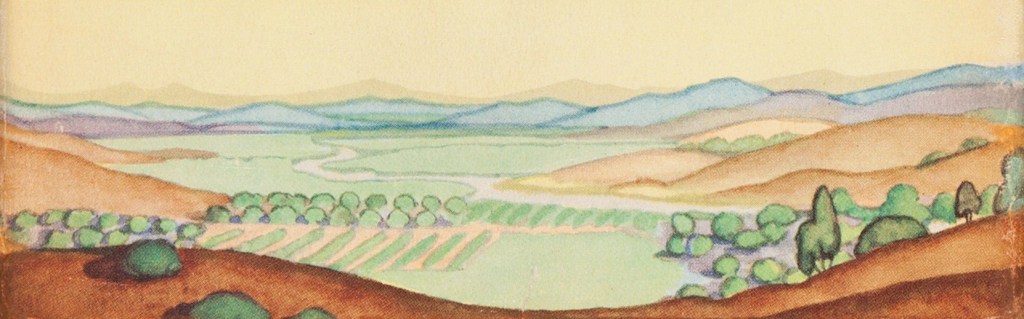
Photo courtesy of Elmer Hader from first-edition dust jacket cover of East of Eden (1952), image licensed by Wikimedia Commons.
John Steinbeck’s 1950 novel East of Eden is widely regarded as a classic of the American literary canon. Steinbeck, inspired by psychological concepts of intergenerational socialization and cycles of harm, traces the lineage of the Trask family, focusing on Adam Trask, both a son and father himself at points in the narrative. Woven throughout the novel is the story of Cathy Ames, a character whose amorality is frequently tied to intense sexual promiscuity, notably at a time in American history when women had minimal agency. Cathy’s insidious actions reveal her complex yet depraved nature—a woman with little regard for others and an intense concern for monopolizing power. While Steinbeck’s portrayal of Cathy as a domineering female antagonist may be considered feminist, her prevailing concern with personal acquisition of power negates this interpretation.
From a young age, Cathy is aware of the power of femininity and sees exploitable weakness in sexuality. The narrator notes that “Cathy learned when she was very young that sexuality with all its attendant yearnings and pains, jealousies and taboos, is the most disturbing impulse humans have” (Steinbeck 60). Cathy’s understanding of sexuality as “disturbing” may stem from a particular incident at a young age. One day, Cathy’s mother finds her daughter “on the floor, her skirts pulled up. She was naked to the waist, and beside her two boys about fourteen were kneeling. […] Cathy’s eyes were blank with terror […] Mrs. Ames saw that Cathy’s wrists were tied with a heavy rope” (61). Cathy is examined by the doctor, who determines she was saved before the situation escalated. The culprits are whipped and sent to a correctional facility. The narrator, assuming the voice of the community, illustrates that “their crime was bad enough, but the lies proved an evil that not even the whip could remove. And their defence was from the beginning ridiculous. Cathy, they said, had started the whole thing, and they had each given her five cents. They had not tied her hands. They said they remembered that she was playing with a rope” (62). If one reads East of Eden sympathetically, they might give Cathy the benefit of the doubt, taking the situation as it looks, like her mother did. Cathy was put in danger by two boys who attempted to take advantage of her, and her assailants were brought to needed justice. However, the narrator’s characterization of Cathy paints this situation with a darker ambiguity. Prior to the incident, Steinbeck explains that “at ten Cathy knew something of the power of the sex impulse and began coldly to experiment with it. She planned everything coldly, foreseeing difficulties and preparing for them” (60). While not explicitly asserted, the narrator’s interjection creates uncertainty, insinuating that Cathy orchestrated the situation her mother saw, per the boys’ claims. This potential truth is strengthened by her father’s skepticism and the way the narrator phrases her mother’s lack thereof. Mr. Ames is suspicious of Cathy, though “he kept the little flame of suspicion to himself. It was better if he didn’t know anything, safer, wiser […] Cathy’s mother […] was so bound and twisted in a cocoon of gauzy half-lies, warped truth, suggestions, all planted by Cathy, that she would not have known a true thing if it had come to her” (62). Not only do Cathy’s parents’ contrasting opinions accentuate the mystery of the situation, but they aid in the undertonal characterization of Cathy as sneaky and manipulative. Though the narrator insinuates that Cathy herself is culpable, the reader never knows the truth of the situation. Cathy is either a victim or unjustly exploiting victimhood.
As a teenager in high school, Cathy enters a similarly dark and ambiguous situation with her Latin teacher. Cathy and her teacher, James Grew, seem to enter an illicit romantic relationship. Grew displays notable signs of infatuation: a “flame leaped in James Grew and some force glowed in his eyes” (63). However, when Cathy presumably ends the relationship, “the flame went out. His shoulders, held so high and square, folded dejectedly. His eyes grew fever-ish and his hands twitched” (63). Later one night, Grew knocks on the Ames’ front door, frantically begging to talk to Mr. Ames, who denies him and returns to sleep. The next morning, “the sexton had found James Grew stretched on the floor in front of the altar. The whole top of his head was blown off. Beside him lay a shot-gun, and beside it the piece of stick with which he had pushed the trigger” (64). This entire episode is unexplained and confusing. The narrator gives no more context. Instead, Cathy provides context, planting a rumour insinuating motive for Grew’s suicide. The narrator hints that such information is false, claiming that this “was Cathy’s method. Before the next day was out everybody in town knew that James Grew had been in trouble in Boston, and no one could possibly imagine that Cathy had planted the story” (64). Beyond this interjection, this seemingly odd anecdote regarding Grew is left unresolved. Like the scene with the boys, Cathy’s implication in the teacher’s death is assumed, but never confirmed. However, much later Cathy brings clarification, admitting: “when I was half-grown I made a man kill himself. He pretended to be good too, and all he wanted was to go to bed with me—a little girl” (245). She clearly lacks guilt, remarking that “he was a fool,” and “I heard him come to the door and beg. I laughed all night” (245). From her perspective, Cathy’s role in Mr. Grew’s death needs no justification. However, her statement complicates the situation: even fools deserve empathy. Her comment is seen on the one hand as a haughty and callous reaction brought on by the resolution of her traumatic experience—Grew got what he deserved. On the other hand, it is a cold, discompassionate reaction to the demise of a sad and lonely man.
In a later situation, Cathy, determined to start a new, more autonomous life, interviews to be hired by a “whoremaster”, Mr. Edwards (71). Impacted by the typical magnetism of Cathy’s femininity, Edwards falls “hopelessly, miserably in love” with her (or her new alias, Catherine Amesbury) (73). The narrator implies her manipulation in constructing this outcome, rhetorically asking, “and this to a girl who had simply asked for a job as a whore—or had she?” (73). Cathy continues to manipulate Edwards, using him to gain a home and money. Edwards “rented a sweet little brick house for her” and “tried to buy her loyalty with presents and with money” (73). However, her exploitation of Edwards is made clear as “to Catherine, Mr. Edwards was as cold a business proposition as his units were to him” (74). “She saw with satisfaction his nerves begin to go […] And when she delicately sensed the near approach of insane, punishing rage, she sat in his lap and soothed him and made him believe […] her innocence. […]She had successfully reduced him to a pulp” (74). Cathy turns Mr. Edwards, a “cold” and “controlling” businessman, into a weak man, dependent on Cathy—not unlike how the women he employs are dependent on him (72-3). Using her femininity, Cathy flips the power dynamic on its axis, defying and even counteracting the patriarchal hierarchy within Edwards’s business. However, in doing so, Cathy is explicitly abusive towards Edwards. Her actions are no longer ambiguous—she is clearly amoral and even sinister. Though the consequence is somewhat anti-patriarchal, it is notable that Cathy’s manipulation does not liberate the many other girls working under Edwards. Cathy does not fight to empower women, only to empower herself.
When Edwards takes revenge on Cathy, beating her almost to the point of her death, she drags her injured body to the porch of the Trask house. While the younger brother, Charles, is suspicious of this mysterious woman, the elder, Adam, feels called to heal her. Cathy feigns innocence, and she and Adam develop a relationship as he nurses her back to health. Quickly, he proposes to Cathy. However, the narrator makes clear that this love story was orchestrated by Cathy all along: “she had not only made up her mind to marry Adam, but she had so decided before he had asked her. She was afraid. She needed protection and money. Adam could give her both. And she could control him—she knew that. She did not want to be married, but for the time being it was a refuge” (94). Cathy intentionally manipulates Adam using her femininity, toying with his emotions to guarantee herself needed sanctuary, income, and protection. However, truly and madly in love with Cathy, Adam is able to control Cathy through his fantasies and skewed power. Adam announces to Cathy that, “‘we’re getting out. We’re going to California” (96). Cathy protests multiple times: “I don’t want to go to California.” “You are my wife,” he said softly. “I want you to go with me.” She was silent and did not speak of it again” (97). In a physically and mentally weakened state, along with her second-rate power as a wife, Cathy loses the agency necessary to assert herself, instead subject to Adam’s whim. Cathy’s own manipulation of Adam works against her. The narrator explains that “perhaps Adam did not see Cathy at all, [rather] an image of beauty and tenderness, a sweet and holy girl, precious beyond thinking, clean and loving[. N]othing Cathy did or said could warp Adam’s Cathy” (102). In California, Cathy’s tether to Adam is strengthened by the discovery of her pregnancy. In her attempts to sever this tie, she unsuccessfully tries to abort the baby. She gives birth to twin boys who she repeatedly asserts that she “do[es not] want” (148). After regaining her strength post-partum, Adam finds his wife “dressed in her neat travelling dress, the jacket edged in black braid, black velvet lapels, and large jet buttons. On her head was a wide straw hat with a tiny crown; long jet-beaded hatpins held it on” (154). Cathy explains to him that she’s “‘going away now’” (154). Caught off-guard and distraught at the thought of losing his perfect wife, Adam locks Cathy in their bedroom. When she convinces him to open the door, she is holding “his .44 Colt, and the black hole in the barrel pointed at him” (154). Cathy shoots Adam, “the heavy slug str[iking] him in the shoulder … t[earing] out a piece of his shoulderblade” (154). While Adam is in pain, Cathy makes her escape, free from the restrictive cage of their marriage. In shooting her husband, Cathy physically reclaims her agency. She rejects the patriarchal practices of matrimony in which a husband holds power over his wife. This, for her, is ‘just deserts’ where the loud bang of the gun makes up for the voice she didn’t have. On the other hand, it was Cathy’s own strategic exploitation of Adam which enables this battle of wills. Adam’s pistol is a weapon that Cathy uses against a tilted power structure, however one which she encouraged through her own manipulative means.
Finally, under another alias, Kate Albey, Cathy joins a brothel, a place which enables her to make her own income so she is self-reliant. She lives in the brothelhouse with other prostitutes, run by a matron named Faye. Cathy once again strategically invokes her sweet and feminine persona, becoming close with Faye. Cathy manipulates Faye into thinking that a girl like Kate, whom she “began to think of […]as her daughter,” should not be a working girl (170). Cathy humbly denies Faye’s request that she stop working, explaining that she needs an income, creating the opportunity for Faye to promote Cathy, who suggests she “could manage the house” (175). Cathy continues to manipulate Faye, to the point where Faye makes out “all [her] worldly goods without exception to Kate Albey” (177). However, though now in a position of high regard at Faye’s side, this promotion is not enough for Cathy. Power-hungry, she sneakily poisons Faye (and herself, throwing off suspicion to make their sickness seem like food poisoning). Faye’s heart is “weakened,” and eventually she dies (191). The brothel, among Faye’s other “worldly goods” is left to Cathy (177). Under Cathy, the brothel becomes a much darker place. The girls “were desperately afraid of her. She kept them that way. It was probable that they hated her, and that didn’t matter either” (360). Cathy maintains her reign in an aptly manipulative manner, in one instance rewarding an employee with a folded paper filled with “little white powder”(242). Though not explicit, this exchange insinuates that Cathy is dispensing drugs to her employees, reinforcing their submission by creating a dependency which only she can fulfill. What began under Faye as a relatively safe haven where girls were able to gain personal agency and income transforms under Cathy into a dangerous authoritarian community, with “no love involved and no respect”, in which girls live under Cathy in fear and uncertainty (360). Cathy’s escape to Faye’s brothel can be seen as empowering and feminist because she gains some amount of freedom and financial security. However, the right to freedom is not enough for Cathy. She moves beyond this goal because of her hunger for power, and in doing so unnecessarily and even intentionally hurts others. There is no sense of justice in Cathy’s murder of Faye, or her maltreatment towards the girls in the brothel. Cathy’s exploitation of the women in the brothel definitively shows the reader that Cathy’s true concern is not equality, but personal power.
It is important to consider Steinbeck’s intentions in conceiving Cathy’s character. Did Steinbeck simply aspire to write a powerful female antagonist or to create a character who is degrading to women? Scholars widely agree that Steinbeck’s second wife, Gwyn, was the model for Cathy Ames. The two fell quickly and passionately in love; however, their marriage only lasted for 5 years as their affection dwindled and Gwyn changed after becoming pregnant—not unlike Cathy (Shillinglaw). In his separate publication, Journal of a Novel – The East of Eden Letters, Steinbeck insinuates the inspiration behind Cathy in a letter to his publisher Pat Covici: “She is a tremendously powerful force in the book. And her name is Catherine or Cathy- Does that give you any clue to her?” (Steinbeck qtd. in “Forgotten Wife – Gwendoline Conger Steinbeck”). In emphasizing the dual names of Cathy (Cathy and Catherine), Steinbeck hints at the link between her character and Gwyn, or Gwyndoline. In light of this connection to the author’s personal life, one must consider Cathy as the concentration of Steinbeck’s potential distaste and even anger towards his ex-wife regarding their failed marriage. Perhaps Cathy is evil because Steinbeck wrote her with hatred toward someone who seemed equally as lovable and enticing, yet ultimately became a source of pain.
Looking at the sum of Cathy’s actions, she balances the gendered scales of justice. Where she and other women are not afforded power, Cathy takes it for herself, seemingly by any means necessary. While such actions may make Cathy out to be a feminist vigilante, the potential of this positive perception of Cathy dissipates upon searching for the motivations of her actions. Though her manipulation of the teenage boys, Mr. Grew, Mr. Edwards, and Adam Trask are more ambiguous, Cathy’s final exploitation in Faye’s brothel, in particular its futility in the realm of social justice, paints Cathy as self-serving, power-hungry, and possibly even psychopathic. This collective analysis, alongside consideration of Steinbeck’s relationship to Gwyn, shapes an image of Cathy around a malignant core. Cathy’s behaviours do not simply oppose the constraining patriarchy, but work to elevate herself towards a final role of monopolizing total control.
Works Cited
“The Forgotten Wife – Gwendoline Conger Steinbeck.” My Life With John Steinbeck, mylifewithjohnsteinbeck.com/about/.
Shillinglaw, Susan. “The Women of East of Eden: Focus on Cathy.” Oprah.com, 18 June 2003, http://www.oprah.com/oprahsbookclub/the-women-in-east-of-eden-focus-on-cathy.
Steinbeck, John. East of Eden. Penguin Books, 1979.
Steinbeck, John. Journal of a novel: the East of Eden letters. Penguin Books, 1990, Internet Archive. archive.org/details/journalofnovelea0000stei/page/184/mode/2up.

