
Written By: Isha Kaur
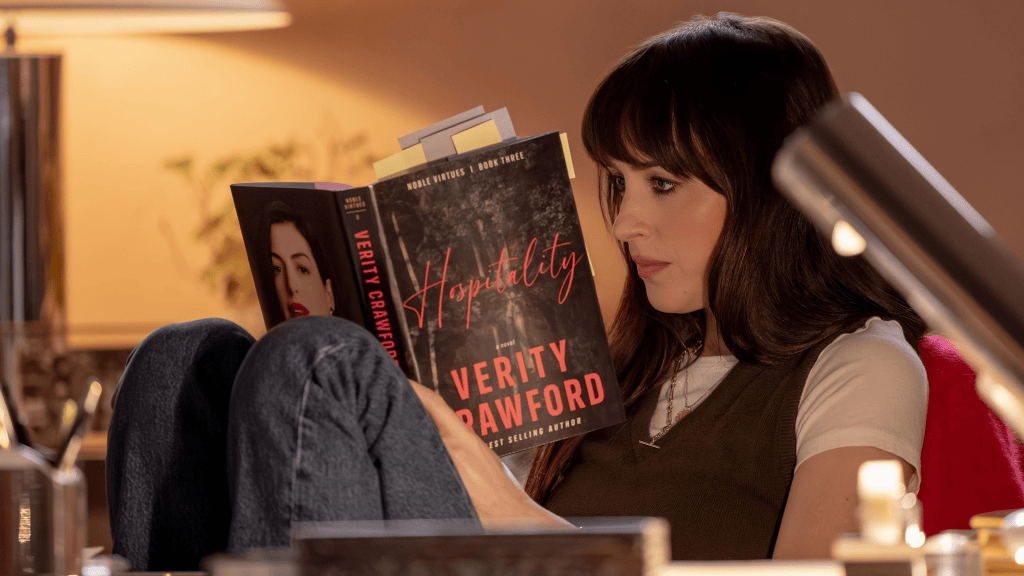
Photo courtesy of Amazon MGM, image licensed by Refinery29
Colleen Hoover’s Verity premiered on October 2, 2026, to a striking divide. Critics have dismissed Michael Showalter’s adaptation as a convoluted comic thriller, with The Hollywood Reporter calling it a “dumb mystery” and The New Yorker a “criminal waste of talent.” Audience reception, however, has been markedly more positive. Many embraced it, drawn to what Purewow reviewer Jillian Quint describes as a film that brings female friends together to laugh and dissect. The irony is difficult to ignore: a film enjoyed by a largely female audience depicts women turning against one another.
The film follows Lowen Ashleigh (Dakota Johnson), a struggling writer hired by Jeremy Crawford (Josh Hartnett) to finish the bestselling thriller series of his wife, Verity (Anne Hathaway), after a car accident leaves her near catatonic, unable to speak or move. Soon after moving to the Crawfords’ isolated Vermont home, Lowen discovers Verity’s secret autobiography, a confession implicating her in her daughter’s death. Meanwhile, Lowen grows closer to Jeremy, steadily assuming Verity’s domestic life.
Writing for Pajiba, an independent entertainment journal, Mae Abdulbaki asks why audiences are primed to believe the worst of one woman while sympathizing with the other. Yet she, like others, concludes that the film stops short of exploring this tension. The film is far from silent; its message is simply uncomfortable. Drawing on bell hooks’ Sisterhood: Political Solidarity Between Women, Verity exposes how patriarchal power is sustained by framing female rivalry as the price of security, where confronting violence would place everything a woman has – her home, her family, and her own safety – in jeopardy, while staying silent keeps it intact. In doing so, the film undermines female solidarity while preserving male impunity.
hooks on Sisterhood
hook’s framework, though developed to examine solidarity within the feminist movement, offers a sharp perspective for reading Verity. She observes that television dramas routinely portray women’s relationships as defined by contempt and competition, and Verity is no exception. For hooks, this hostility is not natural; it is learned. She argues that the male supremacist ideology teaches women that their value comes from their relationship with men, and that other women are “natural” enemies with whom true bonds are impossible. Nor can shared suffering alone be a basis of unity. Bonding on a common victimization, hooks contends, is in and of itself a shallow reflection of the sexist thinking it claims to resist. Real solidarity demands “sustained, ongoing commitment” to shared beliefs and goals, with women consciously unlearning the sexist socialization that casts them as rivals and choosing to confront difficulty together rather than retreat into safety. For hooks, the lessons that set women against one another begin early, passed on in the ways women raise their children. It is fitting, then, that the first bond the film breaks is between a mother and her daughter.
Female Rivalry as a Patriarchal Structure
Among the adaptation’s many changes, one has drawn particular attention from readers of the book. In the novel, Verity and Jeremy have three children: twin daughters. Harper and Chastin, and a son, Crew. The film removes Chastin entirely and makes Harper and Crew twins instead. Many readers have said that removing Chastin eliminates Verity’s disturbing favouritism between her daughters. Yet the change doesn’t erase that favouritism so much as redirect it. Where the novel sets one daughter against another, the film sets a daughter against a son, and Verity’s gendered resentment becomes impossible to ignore. Verity measures her children’s worth against Jeremy’s affection; as such, every bit of attention he gives Harper is framed as attention taken from her. At its root, the rivalry between mother and daughter is a competition structured around one man.
Verity treats the twins as opposites. Her manuscript casts Harper as the danger in the household, a threat she must constantly manage, while Crew is the child she protects. The manuscript details Verity’s attempt to smother Harper as a newborn; years later, it claims, Verity drowns Harper in a lake, under the guise of an unfortunate kayak incident. What the household loses is the daughter, and what it preserves is Jeremy’s son, and with him, the continuity of Jeremy’s bloodline. The violence that permeates the household wounds Jeremy, but does not compromise his position within it. One by one, the women and girls around him disappear.
Why kill the daughter?
Popular culture celebrates the mother-daughter bond as the most natural of female attachments; yet, in Verity, it is the first bond to break. hooks describes how a woman’s worth is secured through her relationship with a man, turning other women into rivals for his affection. A son poses no threat to the stability of the marital relationship; Crew is an extension of Jeremy, not a competitor for his attention. A daughter, however, represents another female presence in Jeremy’s orbit, and the affection he gives her registers as something taken away from Verity. Harper becomes the price of Verity’s security, denied a voice of her own. Everything the audience knows of her, of her behavioural problems, is filtered through her mother’s manuscript. In other words, the girl is defined entirely by another woman’s account. Meanwhile, Jeremy is positioned not as a figure of scrutiny in this battle between wife and daughter, but as a figure of sympathy: the grieving father whose loss frames the film’s premise. By the time Lowen arrives, the story of the Crawford house has already been written: women are rivals, and the man between them is never to blame.
Jeremy’s Impunity
Lowen enters the Crawford home as a stranger and leaves it as a mistress. Over the course of the film, she comes to occupy Verity’s marriage, her role as Crew’s mother, and her career. In other words, she effectively inherits another woman’s life. Each aspect of this replacement serves Jeremy in its own way: Lowen completes the work that sustains his family’s income, cares for his son, and fills the place his wife left behind, all while directing her suspicions at Verity rather than at him. The conflict between the two women restores everything Jeremy has lost without requiring anything of him in return. It is tempting to interpret this as the product of Lowen’s own ambition, and many viewers have, describing her fascination with Verity as an obsession bordering on Single White Female-style jealousy. Yet the film makes clear that this replacement was not engineered by Lowen alone, if engineered at all. From the moment she arrives, Jeremy invites her to stay in the master bedroom, the space that once belonged to his wife, giving her unrestricted access to the kitchen and living room, and allowing her to tune herself to the rhythm of the Crawford family life. Verity, by contrast, remains confined to the second floor, a physical arrangement that effectively isolates her from her own house. Jeremy does not simply allow Lowen to make the house her own; he actively makes room for her to do so. Whether this reflects his intentions all along is a question the film never asks, because his grief shields him from that scrutiny. It is far easier for audiences to read the story as a rivalry between two women than to suspect the mourning father. This instinct to blame women rather than men is precisely what hooks identifies: a culture that teaches women to view one another as natural enemies also conditions audiences to expect conflict between women, encouraging them to overlook the patriarchal structures that produce it.
Lowen’s Complicity
The film’s climax makes this dynamic explicit. After Lowen discovers that Verity may be faking her condition, she shows Jeremy the manuscript. Enraged, he storms into Verity’s room and begins to strangle her. As he does, the film’s visual language builds the expectation that Lowen will step in to stop him. Instead, a medium shot is held on Lowen’s face, withholding the rescue. Where the audience expects her to stop Jeremy from killing Verity, she reveals a darker truth: strangulation would leave evidence, so he should smother Verity instead. This method echoes the manuscript’s account of Verity’s smothering attempt on the infant Harper, as well as Harper’s “accidental” death in the lake. Each death masquerades as something other than murder. Toni Morrison, who hooks quotes, insists that when a woman is harmed, another woman “has to be willing to stay their hands,” that is, to stop the person doing harm. Verity stages precisely this moment, and then denies it. Lowen does not stop Jeremy’s hand; she steadies it, helping him end another woman’s life.
By the end of the while, the cycle of violence has now passed through the home, moving from one woman to the next. Verity sacrificed her daughter to keep her place beside Jeremy; Lowen sacrifices Verity to take it. Each act is committed in pursuit of security, and each secures it only for a man. This is the trap hooks describes. When women choose to avoid confrontation and “always be ‘safe,’” she argues, meaningful change becomes impossible. Safety, in this sense, is not protection from violence, but participation in its perpetuation. hooks warns that not only those who dominate but also women socialized into complicity sustain sexism, and Lowen is rewarded for that; she gains a home, a family, a fortune built on someone else’s life’s work. Jeremy gains even more: a new partner, a mother for his son, and a witness who can never speak against him.
The film’s final scene confirms the pattern. A year later, a pregnant Lowen discovers a letter in which Verity claims the manuscript was never a confession, merely a writing exercise. According to the letter, Jeremy found the manuscript, believed it, and tried to kill Verity for it. Whether her tears express guilt, fear, or grief, the film offers no answer. But she quickly composes herself, hides the letter, and drives away with Jeremy and Crew. It would be easy to dismiss all of this and embrace it as absurd entertainment. But what we watch, and how we choose to watch it, reveals as much about us as it does about the film. A film labelled a “dumb mystery” reveals the very patterns feminist theorists have spent decades identifying. Fiction does not invent these patterns but simply offers them back to us in an easy-to-consume form. Recognizing a pattern is the first step toward refusing it. hooks reminds us that solidarity is not a feeling but an active commitment, one that requires women to stop choosing their own safety at one another’s expense. The women in Verity never make that choice. Its audience, however, still can.

