
Written By: Samantha Rabie
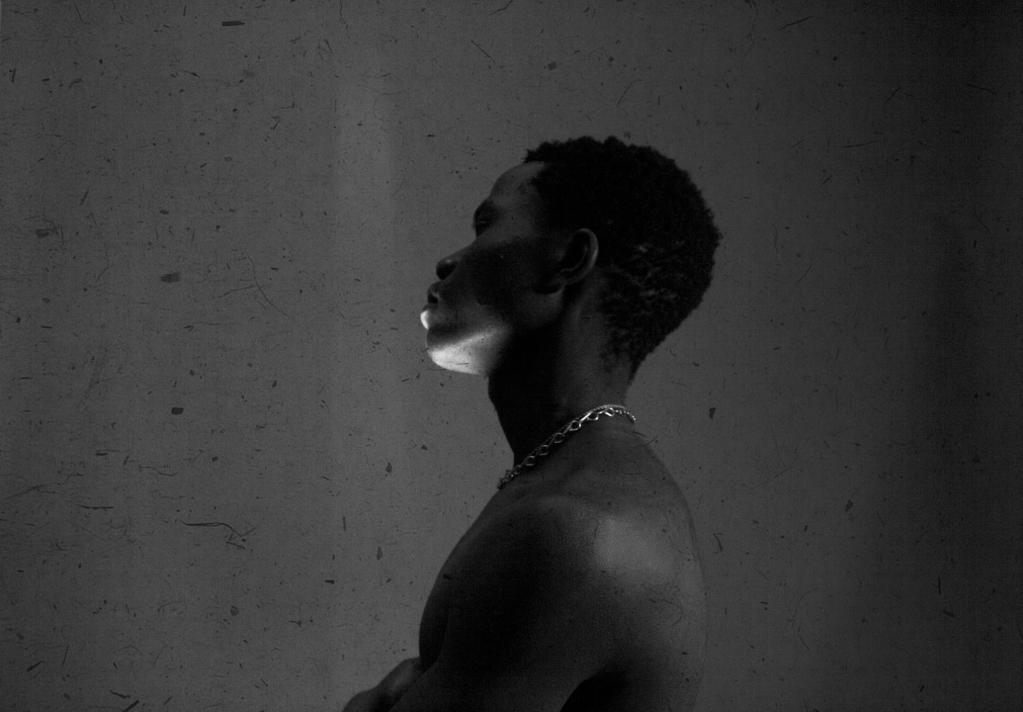
photo courtesy of Olu Family, image licensed by unsplash
Introduction
Frantz Fanon describes a moment on a train in mid-century France in which he encounters himself through the white gaze, a gaze that renders him“an object among other objects.” A white child points at him, “Look, a Negro!”, and the mother’s attempt at reassurance, “Look how handsome the Negro is,” only deepens the estrangement. In this encounter, Fanon becomes hypervisible and invisible at once: looked at and narrated, but never recognized as a human being. His body is no longer his own; he becomes the “BLACK MAN”: a figure produced by white fantasy, overdetermined by fear, myth, and white supremacist ideology. Within this structure, the Black male body is objectified and produced as a phobic entity– becoming a site of fetishization. The “BLACK MAN” is further reduced to the phallic of the ‘BLACK PENIS,’ the metonym through which white society projects its anxieties and desires (Fanon, 1952, p.80). The Black body becomes a threat and a spectacle, hypervisible yet unrecognized, “distorted, demonized, and denied” by white fantasy (Morris, 2016).
In Fanon’s famous train scene, he illustrates both his estrangement from his own body and the larger ontological structure through which white fantasy produces Black male embodiment. This paper approaches these dynamics at the level of ontology, focusing on how the self is formed, understood, and sustained– in other words, the conditions through which a subject comes to exist and be recognized as such. I argue that the racialized construction of Black male sexuality does not merely misrepresent Black men, but enacts a form of ontological violence that distorts the conditions through which Black male subjectivity is constituted. Fanon names this process phobogenesis: the transformation of the Black body into a phobic object, one that absorbs white anxieties, projections, and irrational fears. The Black male body becomes a site for “collective catharsis,” a surface onto which white society discharges its racial panic, sexual neuroses, and cultural aggression (Fanon, 1952, p.103). Once the Black man is positioned as a phobic object, seen before he is known, this fear becomes sexualized. This entanglement of fear and desire is what Fanon names negrophobia: a racialized fear that behaves like a fetish, isolating and exaggerating Black male sexuality into a perceived threat. Rather than existing apart from desire, this threat is constituted through it, taking on an explicitly erotic charge. Wesley Morris, in “The Last Taboo,” demonstrates how this fetishization animates contemporary popular culture’s obsession with the Black penis. Building on this, bell hooks argues that white desire for the racial other becomes a form of consumption: the Black body is imagined as an object capable of offering transformation, worldliness, or escape from the ‘dullness’ of whiteness. In this form of fetishization, Black male sexuality is made to function as a form of labour, in service for the pleasure, guilt-management, or self-fashioning of the white subject, while Black erotic subjectivity is rendered invisible. Yet, as Morris notes, white guilt can also generate a seemingly opposite response, a hesitation to depict Black male sexuality at all (Morris, 2016). This response, too, is a form of ontological violence, for it continues to deny Black men visible emotional and erotic complexity. Taken together, hypersexualization, fetishization, and desexualization constitute interconnected strategies through which white fantasy overdetermines the Black male body. This paper examines these formations as modes of ontological violence, structures that foreclose Black subjectivity and reduce the Black man to a fantastical object rather than a being with erotic and emotional autonomy.
By “phobic object,” Fanon refers to a subject produced as the object of fear through racial fantasy. This fear precedes and structures the encounter
Positionality Statement
As someone who is neither Black nor a man, I write with the awareness that the experiences discussed in this paper are not my own, nor can they ever be accessible to me. My analysis relies on the scholarly work of Black thinkers who articulate the psychic, cultural, and historical dimensions of Black male embodiment in ways I cannot speak to from lived experience. I acknowledge the limits of my perspective and my very contribution as a white person to the structures that reproduce objectification and ontological violence. Occupying a white body means that my subjectivity is the assumed norm against which racialized bodies are constructed as other. While I have experienced forms of objectification, the reduction of one’s entire being into a phobia, into a site of collective fear and sexualized projection, is not something I have lived. I offer this analysis, then, not as an attempt to speak for Black men, but as an effort to critically engage with the structures of thought that shape these racialized fantasies and to remain accountable to the limits of my own positionality
Phobogenesis and the Ontological Making of the Black Phobic Body
The Black body becomes a site onto which white fantasy and anxiety are projected. Fanon names the mechanism behind this process phobogenesis: the making of the Black man into a phobic object. A phobia, as he cites from Hesnard, is a “neurosis characterized by the anxious fear of an object” (Fanon, 1952, p.109). With racial phobia, the fear is not grounded in the actual encounter, but arises from a neurosis of “subjective insecurity,” “defy[ing] all rational thinking” (Fanon, 1952, p.109). In Fanon’s account, this irrationality is not accidental– the anxiety producing the Black man as a phobic object originates in the white psyche itself, in its pre-rational emotional response to childhood anxieties, and inherited colonial fantasies. Although a particular encounter may appear, in retrospect, to have produced this fear in childhood, it does not create it; rather, such moments activate and intensify a structure already in place. The way each encounter is perceived is filtered through a developing white psyche already shaped by racist thinking. Thus, a seemingly mundane childhood moment becomes overdetermined, not by what the Black man does, but by the elaborate structure of white fantasy already in place.
Racial phobia does not simply attach fear to Black men; it produces them as objects of fear, while simultaneously producing the white subject as fearful, binding both within a mutually reinforcing structure. As George Yancy explains, “the white embodied subject is intimately linked to the black embodied subject” (Yancy, 213, p. 21). Black men become a site for everything white society disavows: animality, excess, irrationality, so that whiteness may affirm itself as civilized, rational, and superior. Phobogenesis is not, therefore, mere irrational fear but an ontological act that produces racial meaning, one in which Black being is no longer self-defining or complex but collapsed into a set of undesirable, dangerous, and overdetermined archetypal attributes. Made a phobia, the Black body is imagined to possess an almost supernatural power, a projection that justifies the workings of white supremacy by fastening a set of repellent attributes onto the Black body. These characteristics are so exaggerated that the fantasy of danger comes to overwhelm the reality of his being. This hypervisibility reads as self-authorizing power, an exaggerated presence that makes it seem as though Black men occupy a position of overwhelming force. Yet it is precisely this fantasy of largeness that erases real lived experiences. The Black subject is not encountered as who he is, but as what he is imagined to be capable of. Rather than being recognised as an “actional person” with his own agency, “his actions are destined […] for the guise of the white man” (Fanon, 1952, p.109-110).
The mythic construction of the Black male body carries direct ontological violence, creating a disorienting and dissociative experience. Fanon describes this through the figure of the Black Antillean schoolboy, who is educated through the narratives of the white world, which praise its heroes as explorers on a civilizing mission. Black schoolboys, thus, absorb a gaze that renders Blackness synonymous with barbarity and savagery. In consuming these histories, the child learns to see himself from the outside, through the standards and fantasies of the white world. Fanon shows how this internalized gaze becomes violently intensified when the Antillean man leaves the Caribbean and enters France: there, he is not simply taught about his inferiority but “made to feel” it, forced into a position where his body becomes the screen on which white fantasies of danger, desire, and threat are inscribed (Fanon, 1952, p. 107). This marks the moment when Black people become explicitly racialized, as the individual confronts a profound dissonance, experiencing himself through a phobic myth that precedes and structures his sense of self.
“Antillean” refers to the French Caribbean, particularly the colony of Martinque, where Fanon was from.
Fanon elaborates this psychic rupture most prominently in the train scene, in which he sees himself in “triple” (Fanon, 1952). His sense of self splits into three simultaneous registers: the person he knows himself to be, the person he imagines the white gaze expects him to be, and the fantasy figure that the white child and mother actively project onto him in that moment. His subjectivity and coherence are obscured by the racialized image imposed upon him, producing a disorienting split between lived embodiment and externally assigned meaning. Fanon describes how Black bodies come to “take up room.” This operates on two registers– materially, through their hypervisibility and the regulation of the spaces they are permitted to occupy, and symbolically, through the vastness of the fantasy that overtakes the body, as the white imagination inflates it into an object of fear and fascination that exceeds anything he recognizes as himself (Fanon, 1952, p. 82). This disjunctive experience severs the connection between his mind and body; he becomes a phobic object in the eyes of others even as he retains an interior understanding of himself as a living, thinking subject. His body returns to him only “spread-eagled,” as a mythic figure, fastened by the white gaze (Fanon, 1952, ch. 5). He is thus caught between his lived embodiment and the exaggerated, phobic form that white fantasy insists he inhabit, generating a profound sense of instability, estrangement, and frustration in his own skin.
The Mythic Black Penis and the Collapse of Subjectivity
White fantasy has long “bestowed on the black man powers” that threaten white men’s presumed sexual vitality, imagining him as possessing an ungovernable, almost supernatural power capable of seducing or stealing white women (Fanon, 1952, p. 111). This fantasy allows white masculinity to deflect and manage its own irrational insecurities around sexual inadequacy and dominance by projecting it outward, constructing the Black male body as an exaggerated sexual threat. Within this myth, white women are imagined not as agents but as vulnerable figures who might be overtaken by the danger of white culture’s fantasy of Black sexuality. Here, phobogenesis deepens into negrophobia; the white subject imagines the Black man through a racialized fantasy and reacts to him from within that fantasy, responding not to the individual but to the exaggerated figure of the hypersexual Black ‘predator.’ This is what Fanon exposes in his provocative question, “Isn’t this fear of rape precisely a call for rape?” a line that reveals how negrophobic panic is entangled with erotic projection, producing the figure of the ‘Black rapist’ despite the absence of any actual threat (Fanon, 1952, p. 110). This same fantasy has long fueled and justified immense racial violence, namely, the paranoid belief that Black men sought revenge for the sexual exploitation of Black women during slavery. This belief underpinned the subsequent violent rituals of lynching and castration used to punish Black men for presumed sexual advances or assault, even for merely looking at white women. The myth of the hypersexual, dangerous Black man is continually reproduced through both blatant and subtle mechanisms that mask the fact that this figure is a white supremacist construction, not a reflection of Black men’s lived realities.
The Black male body is, in its entirety, reduced to its penis, as white culture fetishizes the phallus as the single defining marker of Black male sexuality. This erases subjectivity and renders Black men intelligible through a mythological lens that is simultaneously desired and disciplined through white control. Fanon demonstrates the absurdity of this exaggeration through Michel Cournot’s claim that “four black men with their dicks out in the open would fill a cathedral” (Fanon, 1952, p.117). The phallic image associated with Black men is accented such that the man himself disappears; the symbolic penis (not at all related to his actual body) becomes his entire being. The symbolic Black penis is monumental, fantastical, and detached from the body, such that Black male sexuality can never be casual, neutral, and human. Morris extends this logic into contemporary media, noting how the penis has become increasingly visible in film, but only when it is white. The white penis is permitted to be silly, sexual, comedic, and mundane; it can slip into a shot without much reaction because white male bodies are the standard, and ergo their penises. The Black penis, however, is hyperpoliced, treated as excessive, dangerous, and too spectacular to be shown. This is evident in Ted 2, with repeated jokes about “Big Black Dick” (Morris, 2016). When the characters accidentally search the phrase online, the camera pointedly refuses to show the screen, cutting instead to Mark Wahlberg and Ted’s exaggerated expressions of shock and fascination. The humour depends entirely on a shared memory of cultural fiction; the audience is expected to get the joke without seeing anything, because the mythic image of the Black penis is so entrenched that its mere suggestion is enough.
Michel Cournot was a French critic cited by Fanon to illustrate the exaggerated, mythological construction of Black male sexuality in European thought.
Morris’s personal account demonstrates that the mythic Black penis is not simply a cultural joke – it structures encounters, where Black men are not desired as people but evaluated as embodiments of a phallic caricature. He describes a sexual encounter with a white man who grew fascinated with taking his pants off and “gave [his] crotch a long perplexed look” (Morris, 2016). In that moment, Morris was reduced to an object, no longer two people in reciprocal desire, but a body to inspect, a site of erotic curiosity whose value was determined by whether his penis matched the fantastical proportions that white imagination projects onto Black men. Whatever intimacy or emotional build-up existed vanished; sex collapsed into the single question of how his body measured against a myth. Morris further details how Black male sexuality is made into labour, through the expectation that Black men exist in service to their white partners’ pleasure, performing as a spectacle rendered into an object of desire whose own erotic wants and needs are neglected in favour of sustaining the white partner’s fantasy. Thus, Black men are kept in a state of being the desired, but never able to be the desiring. Morris’s account echoes Fanon’s description of being rendered an object as a rupture of selfhood, a moment in which one is pulled out of one’s internal life and made to confront oneself as an object through the white gaze. Just as Fanon is made to feel himself as a “thing” on the train, no longer simply a man but a Black man, Morris, in the sexual encounter, is forced to encounter his own body as an object of racial fantasy (Fanon, 1952, p.117). In both Morris’s and Fanon’s encounters, there is a notable split between lived embodiment and imposed meaning, producing an ontologically disorienting experience, through which ontological violence is enacted.
Alongside hypersexual depictions of Black men that mock and utilize the Black body for spectacle and shock, exist what Morris calls the “mighty movie types”, heroic figures too perfect to be sexual and erotic beings (Morris, 2016). Once again, complexity is erased, but this time in the service of upholding America as a liberal, progressive nation. The Black man is no longer framed as a threat but as moral proof of the moral legitimacy. The hero, in classic Hollywood fashion, becomes the site where racism and misogyny are re-scripted through familiar archetypes, allowing whiteness to reimagine itself as just. Morris references Django Unchained, where Jamie Foxx’s Django, a freed slave, is on a mission of rescue and revenge, saving his wife from bondage. Though the film contains romance, it is imagined through heroic and hypermasculine terms, where Django must remain controlled, stoic, with little room for erotic complexity or emotional vulnerability. Here, Black male sexuality is not mocked but disciplined, where Black men are made respectable through being exceptional. The heroic slave narrative has a historical lineage, evident in earlier literary traditions, such as Aphra Behn’s Oroonoko, where Black humanity is affirmed only through moral superiority, sacrifice, and virtue (Behn, 1688). The Black man is thus permitted recognition only as extraordinary, never as ordinary, desiring, flawed, or erotically complex being. In both narratives of Black masculinity, whether hypersexualized as a laughable, observable spectacle and reduced to the phallic, or elevated into grand moral heroism with sexuality scarcely shown, Black men are exaggerated by white fantasy to fulfill white desire and political agendas. Their bodies become hypervisible, while their subjectivity is rendered invisible.
Commodification and “Eating the Other”: Racialized Desire in Consumer Culture
Running parallel to this history of fearing the Other runs a persistent history of appropriation and commodification, where the racialized Other becomes a resource through which white subjects manage their guilt, boredom, and desire for reinvention. In Black Looks, bell hooks names this dynamic in her chapter “Eating the Other,” describing how white culture turns to Black culture to enliven its own dullness, to feel transgressive without ever relinquishing the protection of whiteness. Sexual encounters with the Other thus become a performance of anti-racism and a claim to worldliness, evidence that the white subject is adventurous, liberated, and unbound by white respectability. The racialized Other’s body, especially the hypersexualized Black male body, is imagined as offering a transformative “conversion experience,” a way to step outside the burden and boredom of “white innocence,” and into something thrilling and life-altering (hooks, 1992, p. 22, 23). As hooks notes, through Foucault, this fantasy promises “complete total pleasure,” a kind of mythic intensity comparable to a drug trip or a spiritual experience in nature (hooks, 1992, p. 26). hooks complicates this further with the concept of “imperialist nostalgia”: the longing for a “primitive” spirit believed to have been lost with modernity, but imagined as accessible through contact with Black bodies (hooks, 1992, p. 25, 27). In this logic, Blackness becomes simultaneously a spiritual escape and a source of social caché and intrigue that can be consumed to increase one’s cultural capital.
Sexual desire becomes a mode of consumption, where white subjects “shop” for sexual partners by markers of race and ethnicity, race functioning like an aesthetic or experience to try on and explore (hooks, 1992, p. 23). Crucially, desire for the Other must remain at the level of erotic intrigue rather than a space for genuine intimacy. To move beyond spectacle into emotional connection would disrupt the fantasy, shifting the encounter from a consumable experience of eating the Other toward a closeness that threatens the purity and status of whiteness itself and producing what hooks describes “as taboo, as secret, as shame” (hooks, 1992, p. 24). With emotional connection, the racialized partner is recognized in their humanity and subjectivity, destabilizing the very notion of the Other and collapsing the fantasy structure that made the act pleasurable in the first place. A more equal and reciprocal dynamic threatens white dominance, disorienting the white subject by undermining the fantasy’s hold on both the white psyche and the control it exerts over the racialized Black body. This desire remains structured by the same fetish logic that Fanon identifies. Here, fear enmeshes with desire and fascination, and the exoticization of the racialized partner prevents a mutually pleasurable and reciprocal experience. The racialized partner thus becomes an object rather than a subject with their own erotic needs, a being whose meaning is overdetermined and controlled by white imagination.
Conclusion
Black men remain positioned as surfaces onto which white culture deposits fear, fantasy, and desire. Reduced to the body, which itself is reduced to the phallic, Black men are rendered not as subjects but as “BLACK MEN”, a phobic category overdetermined by logics of threat and fascination. In this racial mythology, the Black body expands to fantastical proportions, imagined as both danger and erotic spectacle. Fanon names this process phobogenesis, tracing how the Black man comes to inhabit a split existence, caught in what he calls the “triple” structure of selfhood, in which one’s body is prescribed by the white gaze and returned as something foreign, producing a deeply ontological, disorienting experience. Morris explores how this same fantasy persists in popular culture’s fixation on the Black penis, where hypervisibility prevails in fastening Black men both into a laughable spectacle and heroic exceptionalism, both occluding emotional and erotic complexity. hooks examines consumer culture, exposing how white desire itself transforms the racial Other into a commodity through the pursuit of transformation, excitement, and reconciliation with white guilt. Though their methods and contexts differ, Fanon, Morris, and hooks each expose how white fantasy actively distorts Black embodiment and produces harm at the level of being. Through hypersexualization, fetishization, and desexualization, the Black man is produced within a double bind of hypervisibility and invisibility, made to serve the psychic needs of whiteness rather than the desires of Black men themselves. If fantasy reduces Black men to objects, then the counterforce must be the reclamation of Black erotic subjectivity on its own terms, that is, in mutual desire, in intimacy with other Black people, in non-performative sexuality, in vulnerability, and in love. In this sense, the true “last taboo,” as Morris suggests, is not Black nudity, but the cultural acceptance of Black men as capable of emotional depth and ordinary romantic and erotic complexity (Morris, 2016). To imagine the Black man beyond fear and fetish is not to desexualize him, but to finally return sexuality to the register of lived, unpoliced, and self-determined human experience.
References
Behn, A. (1688). Oroonoko.
Fanon, F. (2008). Black skin, white masks. Grove Press, Cop. (Original work published 1952)
hooks, b. (1992). Black Looks: Race and Representation. South End Press. (Original work published 1992)
Morris, W. (2016, October 27). Why pop culture just can’t deal with black male sexuality. The New York Times Magazine . Retrieved December 5, 2025, from https://www.nytimes.com/interactive/2016/10/30/magazine/black-male-sexuality-last-taboo.html.
Yancy, G. (2012). Look, A White! Temple University Press.

