
Written by: Abigail Francis
Edited by: Laurence Desjardins
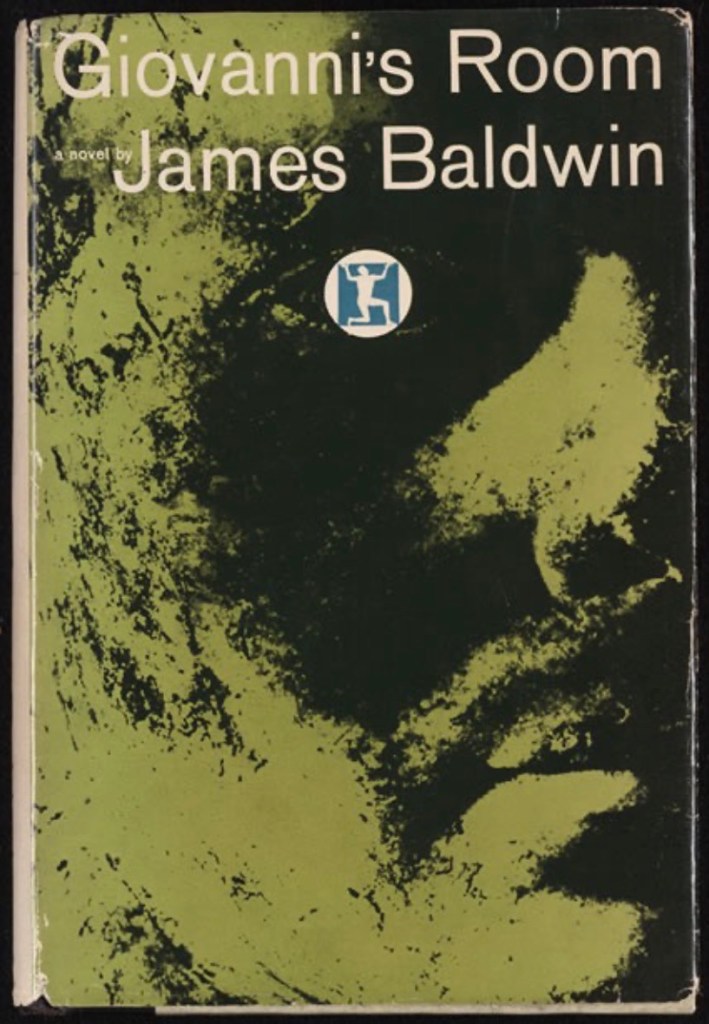
Giovanni’s Room, written by James Baldwin, represents a major cultural reckoning within queer literature; a seminal work that looks at queer love through the eyes of shame and guilt. At its core, the book is about an overwhelming and inescapable feeling of fear. The novel examines what it means to be queer in a society that brutally punishes homosexuality, and how those punishments become internalized to shape self perception. David, the main protagonist, is an American who flees to Paris to begin his unsuccessful search to “find [himself]” (21). When the novel opens, David has just asked his girlfriend, Hella, to be his wife. As she ponders on whether or not to agree, she leaves on a trip to Spain while David seems to be idle and “could not even pretend to [himself] that [he] was sorry she was in Spain” (42). We learn that David’s also, in part, running away from his long-suppressed sexual feeling towards men, which in the US was seen as completely unacceptable for the time. Although Paris in the 1950s was still not as progressive as the US, some communities allowed for more public displays of homsexuality. From the very beginning, David declares that he will “allow no room in the universe for something which shamed and frightened [him].” (20) However, one night, David meets Giovanni, an Italian bartender who he finds attractive, flirtatious, and charming. After Giovanni’s shift the two share an early morning breakfast, and Giovanni invites David back to his room, a space David will come to inhabit for a few months.
James Baldwin and the 1950s
James Baldwin was born in Harlem, New York, in 1924, but spent much of his early career in Paris, having moved there at the age of 24. By moving to Paris, Baldwin escaped the oppression of American racism and was free to write about a variety of prohibited subjects, such as homsexuality and civil rights. It was in Paris that he wrote his first two novels: Go Tell it on the Mountain and Giovanni’s Room and where he built his reputation as a pioneer for queer and anti-racist literature.
The main themes in Giovanni’s Room are ongoingly rendered subjects of controversy. Before being published in 1956, the manuscript was rejected by Baldwin’s editor, Alfred A. Knopf, who claimed that the reader “feels too distant from the [narrator] and only watches in fascination” which ultimately “set the wrong kind of cachet […]and estrange many of [the] readers.” However, Baldwin believed that his manuscript was indeed rejected because of its content but refused to give up. In Baldwin’s words: “They said I would—I was a Negro writer and I would reach a very special audience…And I would be dead if I alienated that audience. That, in effect, nobody would accept that book—coming from me…My agent told me to burn it.” He instead sent the manuscript to other publishing houses until it was eventually published by the Dial Press. Its reception had mixed reviews; despite the controversy of the subject matter, The Atlantic praised the novel for its artistry and depth, arguing that the book should be a “top rank of fiction concerned with homosexuality.” In light of this, Giovanni’s Room was a finalist for the National Book Awards in 1957. On the other hand, some criticized Baldwin for wasting his talent on a story about white, gay love instead of focusing on the Black experience in America.
A Look at Shame and the Grotesque
David walks a line between love and resentment for both his lovers, Giovanni and Hella, and even his friends Jacques and Guillaume, who are openly queer. These friends were close because of their familiarity with one another, “by being in their company a great deal” (23) and because Jacques and David shared safety in their shared queer identity. At one point, Jacques even encourages David to look past his shame and to, “make [his] time together” with Giovanni “anything but dirty” and “give each other something which will make both of [them] better…if you will not be ashamed” (57). However, David does not necessarily like him, instead finding Jacques “a fool and a coward” yet admitting that “almost everybody is one or the other and most people are both” (23). Furthermore, David likes to take advantage of his friendships, especially Jacques, who he frequently asks for money. David’s ambiguous feelings reflect a tension between seeing Jacques as a safe space for David to express his homosexual desires and as a figure of disdain that reflects his internalized homophobia.
David’s hunger for his “manhood [to be] unquestioned” (104) underscores the extent of his internalized homophobia. Because David equates heterosexuality with masculinity, he comes to see homosexuality as a feminizing force threatening to expose him to weakness and humiliation. In David’s mind, to desire another man is to relinquish the stability and social privilege attached to masculinity. David repeatedly characterizes homosexual men as grotesque, projecting his fear of social exposure and gender deviance onto those who openly embody the desires he refuses to acknowledge in himself. This is a destructive force throughout the novel. This tension is shown when David notices a drag queen and declares that “his utter grotesqueness made [him] uneasy; perhaps in the same way that the sight of monkeys eating their own excrement turns some people’s stomachs. They might not mind so much if monkeys did not – so grotesquely – resemble human beings” (27). In other instances, he describes queer people through a series of metaphors, comparing them to animals first as “screaming like parrots” (26), then as peacocks occupying a barnyard. David is constantly wrestling with this dichotomy, and by putting others down he expects that he, himself, will become more in tune with a heterosexual “masculine” identity. In othering those who openly embody the desires he fears in himself, he attempts to distance himself from them, as though proximity to their deviance threatens his own claim to manhood.
The whole novel shapes an anatomy of confusion, fear, and shame, in tandem with the tabooness that perpetuates homosexuality in the 50s. David’s relationship with Giovanni becomes the clearest site where shame does its damage. David’s attraction to Giovanni was like “moving into the field of a magnet or like approaching a small circle of heat” (27-8) and seeing Giovanni’s face illuminated from David’s conversation after just one afternoon together, David realizes he would “be willing to give a great deal not to lose that power” (83). Later, David confesses of his love towards Giovanni: “I loved him. I do not think that I will ever love anyone like that again” (112).
The Tiny Room on the Outskirts of Paris
Simultaneously, as David finds himself in Giovanni’s tiny room on the outskirts of Paris, he quickly frames it as “stinking and dirty” (135). David imagines the room as being morally contaminated. The repetition of this description later to Hella after her return to Paris when speaking about his “friendship” with Giovanni reveals that the room functions rhetorically, becoming a narrative of justification for his homosexual feelings. By labelling the space as filthy, David converts his fear and self-loathing into something external and tangible. Dirt is easier to clean than desire, which David obsesses over to clean. David’s narrative of Giovanni’s dirty room is what makes Giovanni’s rebuttal so devastating near the end of the novel. When David chooses to abandon Giovanni upon Hella’s return, Giovanni openly calls out the disgust behind the moral evasion: “You want to leave Giovanni because he makes you stink. You want to despise Giovanni because he’s not afraid to stink of love. You want to kill him in the name of all your lying little moralities” (141). This tension is specifically shown through the power struggle between the two men. Giovanni seems unafflicted by the shame that eats away at David. David absorbs the full weight of it, burdened simultaneously by guilt over his homosexual relationship with Giovanni and his perceived obligation to Hella. Giovanni becomes threatening as he sees David clearly for who he is and names his fear. It is precisely because he refuses the moral myths that David depends on and its of these myths in which David ultimately decides to leave Giovanni’s Room forever.
Hella, David’s fiance, fits neatly into his vision of what love is supposed to look like. If Giovanni represents desire in its most exposed and destabilizing form, Hella represents structure, legitimacy, and comfort. Her love is orderly with clear normative direction that is socially legible. Mostly, she offers David the possibility of marriage. Yet his attachment to her is less about true passion than about preservation. Hella becomes a safeguard against the aspects of himself he fears most; she allows him to imagine that his time with Giovanni was temporary–a detour rather than any sort of defining truth. In this sense, David does not love Hella freely, but instead clings to her. She embodies the heterosexual future that can cleanse him.
David’s inability to fully reject his heterosexual ideals produces an anxiety that prevents him from fully embracing his relationship with Giovanni. When Giovanni brings him to the room, David imagines it as a space he has been invited to “destroy… and give to Giovanni a new and better life” (88), framing intimacy not as mutual desire but as a project of correction and improvement. Rather than confronting the homosexual nature of the relationship, David recasts his role within it, by presenting himself as Giovanni’s “housewife” with “a kind of pleasure” (88), importing familiar constructs of traditional gender roles and the upkeep of cleanliness into Giovanni’s room. He stays in the room, like a traditional housewife, while Giovanni goes to work night shifts at the bar. This dynamic allows David to domesticate the relationship and render it legible through heterosexual norms, even as its homoerotic foundation remains unchanged. David would rather feminize himself within a recognizable gender hierarchy than accept himself as a man who desires other men, revealing that his fear lies not only in homosexuality but in the collapse of the masculine identity he believes he must uphold. He struggles with this however, admitting that “men never can be housewives. And the pleasure was never real or deep…[he] was in a terrible confusion” (88). In a moment of painful clarity, David understands that rejecting Giovanni is not an assertion of his masculinity but a confirmation of its fragility:
“With my hand on the knob, I looked at him. Then I wanted him to forgive me. But this would have been too great a confession; any yielding at that moment would have locked me forever in that room with him. And in a way this was exactly what I wanted. I felt a tremor go through me, like the beginning of an earthquake, and felt, for an instant, that I was drowning in his eyes…Then something opened in my brain, a secret, noiseless door that swung open, frightening me: it had not occurred to me until that instant that, in fleeing from his body, I confirmed and perpetuated his body’s power over me” (144).
Furthermore, David’s haste to clean the room also represents his eagerness to organize his inner turmoil. Giovanni’s room, often referred to as “the room,” is used as a metaphor for all the turmoil of their relationship. David’s desire to restore order only exacerbates his feeling of confinement which leads him to start resenting the room itself. David saw the room as part of “Giovanni’s regurgitated life” (87) as well as “a matter of punishment and grief” (87). However, it is the only place where David can truly express himself without the watchful eye of Paris, which makes his harsh judgment of the room all the more cruel and ironic. For David, the room becomes both a sanctuary and a sentence, offering safety for his queer desires while simultaneously forcing him to confront them. Unable to reconcile this duality, David externalizes his shame onto the room, transforming a site of intimacy into evidence of his own perceived moral failure. And once he comes to realize this, he feels an overwhelming drive to leave.
“The table was loaded with yellowing newspapers and empty bottles and it held a single brown and wrinkled potato in which even the sprouting eyes were rotten. Red wine had been spilled on the floor, it had been allowed to dry and it made the air in the room sweet and heavy. But it was not the room’s disorder which was frightening, it was the fact that when one began searching for the key to this disorder one realized that it was not to be found in any of the usual places. For this was not a matter of habit or circumstance or temperament; it was a matter of punishment and grief” (87).
The Microclimates of Feeling
Let me tell you about the yearning: the microclimates of feeling and aesthetic splendor that Baldwin provides within the pages of Giovanni’s Room. One of my favorite aspects of the book is the way Baldwin carves out emotional spaces that exist almost independently from the world around them. The love between Giovanni and David unfolds within these microclimates of feeling, or pockets of intense infatuation and intimacy where time seems suspended and where external judgment momentarily dissolves. Baldwin renders yearning with extraordinary precision; the desire between the two men is palpable, thick, and consuming. When David and Giovanni are together, they entangle themselves in these emotional atmospheres, sealed off from the moral scrutiny of Paris and the futures they both fear. These microclimates are powerfully written and some of the most beautiful parts of the book.
“Giovanni had awakened an itch, had released a gnaw of my life in me. I realized one afternoon, when I was taking him to work via Boulevard Montparnasse. We had bought a kilo of cherries and we were eating them as we walked along. We were both insufferably childish and high-spirited that afternoon and the spectacle we presented, two grown men jostling each other on the wide sidewalk and aiming the cherry pits, as though they were spitballs, into each other’s faces, must have looked outrageous. And I realized that such childishness was fantastic at my age and the happiness out of which it sprang yet more so; for the moment I really loved Giovanni, who had never seemed more beautiful than he was that afternoon. And, watching his face, I realized that it meant a lot to me that I could make his face so bright. I saw that I might be willing to give a great deal not to lose that power. And I felt myself flow toward him, as a river rushes when the ice breaks up” (83-4).
Yet, these microclimates become unsustainable under shame. They cannot last and as the novel trends towards the end, when David leaves Giovanni, we see almost a clinical storyline come into writing. Emotions flatten, events are recounted with distance, and the intensity that once defined the relationship drains from the prose. David cannot seem to love anyone anymore. In fact, he repeatedly admits to “[feeling] nothing” (138,161) for neither Giovanni or Hella as he steps away from all types of love. The collapse of these emotional microclimates reveals the novel’s deepest tragedy: it is not that David cannot feel love, but that he cannot face any sort of the vulnerability it demands of him.
My Final Thoughts
On a 5 star scale, I would give this book a 5. Not only was this an entertaining and extremely well written read, it is an important read. Set within an unaccepting world, Giovanni’s Room offers a rare and intimate glimpse into what it meant to love someone of the same gender in the 1950s, without romanticizing the constraints that made such love so fragile. Baldwin refuses to frame queerness itself as tragic; instead, he exposes how shame, fear, and moral rigidity corrode intimacy from within no matter the gender.
David’s struggle is painful not because his desire is wrong, but because he lives in a world that teaches him to experience it as such. In tracing this internal conflict, Baldwin offers a story that feels both historically grounded and unsettlingly contemporary. Giovanni’s Room matters because it insists that the cost of denying love to oneself can be destructive to the physical body and psyche. So, read Giovanni’s Room and can almost guarantee you will love it too.
 Intersections