
Written by: Amy Xia
Edited by: Laurence Desjardins
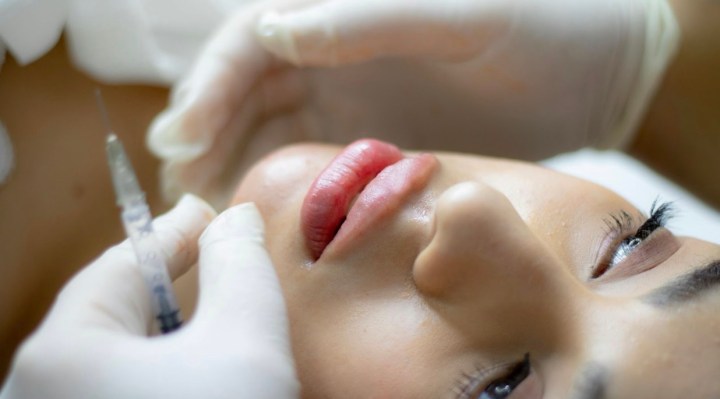
In 2022, over 26.2 million cosmetic and reconstructive procedures, including minimally invasive procedures such as Botox and dermal fillers, were performed in the United States alone. The ongoing trend of plastic surgery and cosmetic enhancements is apparent: from 2019 to 2022, the number of procedures performed increased by 19%, a substantial figure in such a short time frame. What was once considered extreme and radical—surgical alteration of one’s face or body—has become routine maintenance. Cosmetic enhancement is increasingly framed as empowerment: a declaration of autonomy, confidence, and self-investment, dangerously disguised under the propagandistic facade of “my money, my body.” Yet beneath this connotation of choice lies a more complex dynamic. What appears to be individual agency may, in fact, be an exploitation of individuals’ bodies, bodily images, and bodily affirmations by powerful structural and institutional forces.
The process begins with normalization. Treatments such as Botox, lip fillers, jaw reshaping, and skin resurfacing are no longer presented as dramatic transformations, but rather as subtle refinements. Social media is filled with “before-and-after” videos that emphasize minimal change—just a smoother forehead, a slightly lifted brow, a subtly contoured chin. Even though each of these individual interventions is designed to be inconspicuous, they collectively redefine what counts as natural. Furthermore, as more individuals undergo subtle procedures, those with unaltered, natural faces begin to appear tired or aged. The baseline of socially perceived beauty shifts. Cosmetic enhancement becomes less about reinvention and more about keeping pace with a collectively upheld standard.
This moving standard operates within what can be described as an influence economy. On platforms such as Instagram and TikTok, the face functions as a brand. Public exposure, symmetry, youthfulness, and photogenic features are rewarded both financially and through likes, followers, and more exposure by recommendation algorithms. Influencers such as Kylie Jenner have publicly shaped beauty trends, popularizing lip augmentation and contoured facial structures that, in turn, influence global markets. Even beyond celebrity culture, ordinary users alter their appearance for social affirmation and acceptance. The face becomes a public interface tied to opportunity, attention, and sometimes income. Under these conditions, cosmetic procedures can feel less like indulgence and more like a rational investment.
The pressure to optimize appearance is no longer purely aesthetic; it is economic. In industries reliant on image such as media, fashion, and even in corporate environments, presentation influences credibility, opportunities, and even success. Sociocultural theory helps explain this phenomenon by suggesting that beauty standards are cultural products transmitted through institutions such as media, peers, and family. When these institutions consistently reward certain features, individuals internalize them as desirable standards. Consequently, adopting external beauty standards as personal goals intensifies dissatisfaction with one’s appearance. Thus, the desire for cosmetic enhancement may not originate solely within, but rather from deeply absorbed, and thus internalized cultural signals.
The normalization of intervention also reshapes moral expectations. Beauty is no longer perceived as something one simply possesses; it is something one is responsible for earning. Skincare routines, fitness schedules, dietary discipline, and cosmetic treatments are framed as evidence of self-management. Looking polished signals responsibility and ambition. Failing to regularly maintain one’s appearance can be interpreted as laziness or neglect. Beauty becomes moralized. The implication is subtle yet powerful: if improvement is accessible, choosing not to pursue it appears irrational and unacceptable.
Self-discrepancy theory offers insight into the emotional consequences of this environment. Individuals compare their “actual self” to an “ideal self” constructed through repeated exposure to curated images. The greater the gap, the stronger the feelings of dissatisfaction or inadequacy. Social Comparison Theory further explains how individuals evaluate themselves against others, suggesting that people determine their social values by comparing themselves to others in terms of “attractiveness, wealth, intelligence, and success.” In a digital ecosystem saturated with filtered, enhanced, and surgically refined faces, comparison becomes constant. Each scroll means another unconscious self-assessment. Over time, repeated exposure to particular aesthetic ideals—smooth skin, symmetrical features, narrow waists—makes those ideals seem normal and attainable. What was once exceptional becomes expected, creating a wider gap between the perceived expected and the actual, resulting in deeper dissatisfaction and even destructive behaviours and mental disorders such as disordered eating. While men also face increasing pressure to look good, the social consequences differ. Body modification practices among men may be minimized, and male body dissatisfaction often manifests in different patterns of disordered eating or exercise compulsion. Nonetheless, the intensity, frequency, and early onset of appearance-based scrutiny continue to disproportionately impact women and girls.
According to Objectification Theory, women, in particular, are socialized to monitor their own appearance from an observer’s perspective, thus having their bodies treated as objects to be viewed and evaluated. This internalized gaze reinforces the perception that the body exists for external validation. Cosmetic enhancement, within this framework, becomes a tool for preventing social scrutiny and judgement. The decision to alter one’s appearance is therefore shaped not only by personal taste but by the anticipation of judgment. The consequences of these shifting norms are tangible. Individuals who align with dominant beauty standards often receive social advantages—greater visibility, increased attention, and sometimes professional success. Studies in organizational psychology have shown that attractive individuals may earn higher salaries and be perceived as more competent. Conversely, those who deviate from prevailing standards may encounter subtle stigmatization or diminished legitimacy. The celebration of certain features is not neutral; it reinforces hierarchies that shape everyday interactions.
Within such a system, cosmetic enhancement can feel voluntary—but does this mean it is indeed voluntary? Choosing to undergo Botox or fillers may reflect some degree of independent agency that still persists. Yet the language of empowerment—my body, my choice—captures the surface of the decision, but not the environment that conditions and motivates it. When appearance is framed as capital, investment in that capital appears rational. It is thus especially important to resist oversimplification. Cosmetic procedures do not uniformly produce dissatisfaction; many individuals report increased confidence and satisfaction following treatment. However, recognizing genuine personal satisfaction does not negate structural influence. Sociocultural pressures and internalized standards shape the very desires individuals experience.
Ultimately, cosmetic enhancement exists at the intersection of autonomy and structure. It is neither pure self-expression nor pure coercion. Rather, it represents a patterned response to a social environment that assigns value unevenly. When beauty becomes measurable through engagement metrics, economic opportunity, and social affirmation, the line between free choice and structural incentive blurs. To question this system is not to condemn those who participate in it, it is to examine how standards are collectively produced and how they shape desire itself. If bodies are rewarded or penalized for alignment with aesthetic norms, then cosmetic enhancement reflects not only personal aspiration, but also social calculation. In recognizing this, we move beyond the surface narrative of empowerment and toward a deeper understanding of the quiet architecture that influences choice.
 Intersections