
Written by: Lauren Avis
Edited by: Laurence Desjardins and Louise Deroi
On the morning of October 8th, McGill’s main campus was cast with grey clouds and a tangible loss of energy from the previous day where students were met with armed SVPM guards in riot gear. While the police have seemingly left campus, leaving piles of horse dung in their wake, the perennial watch of McGill’s private security endures.
Twenty-four hours after 81, 000 students across Montreal’s universities and CEGEPs went on strike in solidarity with Palestine, entrances across campuses remained blocked by one, sometimes two, GardaWorld guards. In a year where the administration’s austerity cuts have slashed academic spending, the presence of salaried “patrol” officers heavily monitoring students’ actions raises many questions as to whether McGill prioritizes its property over its students’ wellbeing. Does student activism, in particular pro-Palestine activism, warrant such security measures? Moreover, does McGill seek to protect the student body, or completely police it?
The McGillian Panopticon
In 1789, philosopher Jeremy Bentham began his design of the Panopticon—an all seeing prison, in which the perceived risk of surveillance constitutes surveillance in itself. Bentham believed that prisoners’ perception of being constantly surveilled ensured proper discipline by prisoners, with the prison guard’s omnipresent authority ideally managed by the supervision of the public.
McGill’s administration seemingly subscribes to Bentham’s theory of managing student behaviour through surveillance. Instead of a prison’s inspector, surveillance is performed by private guards wielding camera phones and undercover agents hired from private investigation firm Sirco. Since the 1960s, the University has had a significant history of aggressively reactionary responses to any perception of student ‘radicalism.’ As university administrations have long viewed demonstrations of student activism as deviant, perhaps even criminal, their liberal use of surveillance and security to monitor student behaviour replicates the carceral panopticon.
Order is maintained through deterrence: any action deemed disruptive could result in your image and details being logged and potentially used against you. Fifteen years ago, when students were reported to be committing a non-permitted activity, security would take the students’ ID number, name, and description of the offending event which was passed to the Dean of Students. With the surveillance technology that has since developed and guards’ use of personal cellphones to gather information, guards now own substantive evidence to use against student activists.
Pro-Palestinian Activism and Increased Security Measures
The use of private security and its constant surveillance have increased in response to student body’s ongoing calls for McGill’s divestment from materiel that is actively contributing to the ongoing genocide of the Palestinian people. The BDS (Boycott, Divest, and Sanction) movement has long been the subject of McGill’s paranoia. ‘Disruptive’ protests, associated with left-wing demonstrations that question McGill’s financial ties and policies are often met with campus security.
The phenomenon finds itself reinvigorated in the context of Palestine. Since October 2023, security has been employed to monitor student mobilization on campus. Students reported a deep sense of mistrust and anxiety in identifying themselves with the Palestinian movement out of fear of reprisal from the University’s administration: Students wearing keffiyehs are being followed and filmed following a communique published by McGill which stated that participants in the 2024 encampment would be subject to sanctions and legal reprise. During the tenure of the encampment from April to June 2024—before it was dismantled by Groupe Sirco, the private investigation firm hired by McGill—the panoptical use of guards was palpable, and it remained after the dismantlement.
Sirco employees, undercover but exposed by their earpieces and insecure gazes, were scattered around campus to further investigate and survey student activists. McGill’s statement announcing an “increase [in] the presence of security staff near the encampment and elsewhere on campus” was just that:vague and non descript. Every year as October 7th approaches, McGill increases security and restricts access to campus, checking IDs, searching bags and sometimes detaining students. This year, when the motion to strike was approved, McGill was clear on its stance: “Facility code” which has not been defined, would be activated, and students could expect the watchful eye of GardaWorld marking entrances all across campus.
Safety or Surveillance?
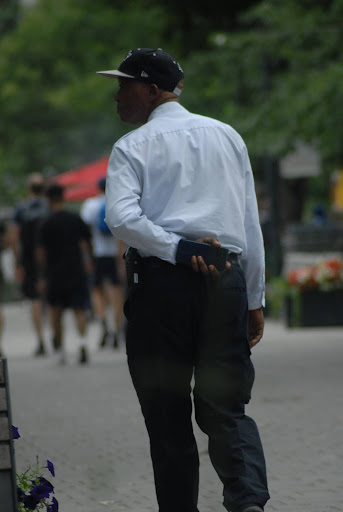
At Milton Gate, a Guarda employee paces, shifting his gaze between his phone screen and the students. He stands awkwardly, with notable flicks of interest whenever someone with a watermelon keychain or keffiyah-esque pattern passes. McGill has continued to justify their spending on private security as a necessary measure to respond to students’ unrest. In 2012, responding to protests against tuition hikes, McGill cited property damage and student safety as a reason for their “responsible and effective” spending on security. Today, their justification remains the same. When asked about the heightened security presence during the previous student strike from April 2nd – 4th, 2025, the $4.6 million expenditure on Groupe Sirco, and that their presence are not making students feel safe, McGill pointed to classroom disruptions and vandalism as validation. In the same response, admin failed to address the fact that “64% of students report that the heightened security presence on campus has not made them feel more safe at McGill.” Universities are instructed by risk management enterprises to encourage campus security to watch for intimidating behaviour, but the qualifications of what constitutes such behaviour is unclear. For students who did welcome increased security on the anniversary of October 7th, Montreal universities were nonetheless criticized for signalling security without substance: If a sense of safety for the student body is truly something that McGill’s employment of private security is there to provide, who actually feels safe?
The Watched and the Protected
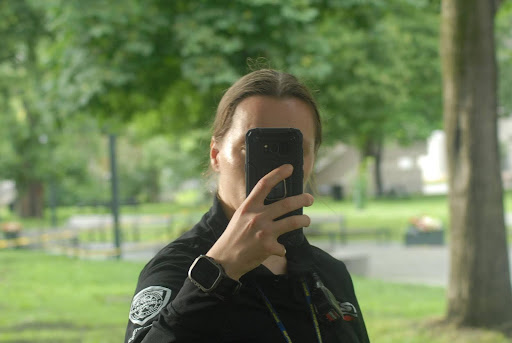
Asa Kohn, interviewed by Intersections earlier this month, is no stranger to McGill security. Her long brown hair, eye colour, height, and attire have all been carefully noted down by guards in the process of her tracking McGill’s use of private security. Not only has Kohn faced physical assault from private guards on McGill property, but she has additionally been stopped more times than she can count – sometimes by plain-clothed guards who refuse to identify themselves, blatantly disregarding the Private Security Act that mandates them to do so. She has been filmed at various points capturing troubling shots of Sirco and Garda employees ‘subtly’ pointing their camera phones at her.
McGill’s general statements regarding their use of security in response to student mobilization maintain that the motivation is to protect students and private property. But who is protected? Beyond the public performance of campus security to the public, as a general premise, increased security and the oftentimes ensuing overzealousness in their authority has long been reported to “promote mistrust, fear, self-surveillance, and, ultimately, self-censorship.”
This is not to say that McGill is not reacting to a clear demand.Organizations such as Federation CJA and Hillel Montreal have pressured universities across the city to commit to concrete security measures, but there is little evidence in campus security’s ability to provide or follow them. Conversely, increased surveillance undermines students’ security in their expression and engagement with ‘countercultural’ ideas. Being surveilled is internalized most deeply in marginalized students who face higher rates of profiling and reprisal and are oftentimes inherently linked to the cause solely through their ethnicity.
University Affairs has received numerous anecdotes from Black and brown students alleging being trailed by security. By constantly being policed, the student becomes a prisoner whereby expression is criminalized. Yes, there is objective criminal activity on the side of student activists, often charged with the loosely-defined crime of mischief. In the past two years, windows have been smashed, walls have been vandalized, and a flag was burned… These crimes that the administration so vehemently denounces all involve the destruction or alteration of private property, showing the administration’s clear focus on property protection. It’s hard to extract a net positive in assessing McGill security’s contribution to student safety.
After she was assaulted , Asa Kohn struggled when finding herself on campus, constantly met by the eyes of those who were involved in the incident yet face no oversight or body of accountability. While Asa is steadfast in her activism, the physiological impacts of trauma are nonetheless enduring.
Cost of Control
In a year where McGill’s austerity is cutting academic programs and positions, it is not exactly innovative to wonder where exactly the money for these security measures is coming from. McGill’s security spending surpassed $8 million in the 2024-2025 fiscal year, with an aforementioned amount of $4.6 million delegated to SIRCO, responsible for extended monitoring and enforcement duties. The rest, seemingly towards Garda, is contracted to oversee patrols, conduct surveillance, and control campus’ access points. The quasi-paramilitary are qualified by the following:
- Holding a high school diploma or equivalent
- Valid Québec Security Guard Licence (BSP)
- 1 year of experience
- Bilingual
This is not to discount the hard training of our boys in dark blue(?), grey (?), black (?), undercover (?), nor their campus training program, but what exactly corroborates McGill administration’s belief that this is an appropriate way to address student activism, especially in relation to an ongoing geopolitical conflict that touches many of the student body?
There is of course the obvious social cost, in which the dissonance between the student body and the administration has prevented meaningful dialogue, and has led to a blatant disdain for students’ rights to assembly and protest, which was recently affirmed by the Québec Superior Court. McGill has earned a reputation for its heavy handed approach in treating its students like criminals when they are exercising the very values that the institution claims to promote. This is not new, but the transformation of technology has allowed for a new invasion into student privacy and their right to assembly. In the current financial and social environment, McGill’s gluttonous use of private militarised security transforms the university experience of every student regardless of their political activity.. Everyone is being watched in the panopticon.
When Bentham first posited the Panopticon, the philosophical question that arose was “Who guards the guard?” To him, it was the public that would keep the guard in line. As McGill consolidates its response to dissent as one of increased surveillance and paranoia, it is clear that the onus is once again put on the public to protect students against the criminalization and policing of their right to expression and assembly. Pervasive surveillance and its social and financial implications make McGill’s justification of safety for students fall flat, but the seemingly large disconnect between the administration and the student body has shown no signs of stopping.
Images taken by Asa Kohn
 Intersections