
Written by: Abigail Francis
Edited by: Orli Adamski
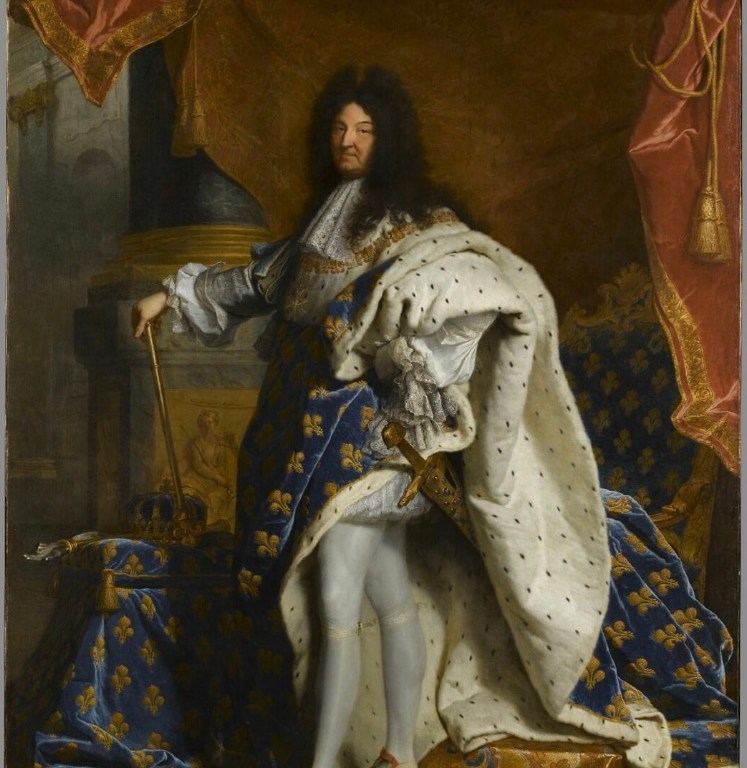
Fashion has never been apolitical. In fact, as with any art form, fashion often reflects and can enforce the political and social order of a given time. Dress codes, in and of themselves, have illuminated how social roles and hierarchies play into everyday dress. Take the civil rights movements in the 1960s: many African Americans wore their “Sunday best,” including well-tailored suits and dresses, when protesting for equal rights. This deliberate form of dress communicated dignity, seriousness, and respectability, signalling to the public that demands for racial equality were legitimate while undermining dominant narratives about the sophistication of Black People. Take a look at the 18th-century portraiture of upper-class men in comparison with contemporary men’s fashion.
When looking at the fantastical and opulent jewels and raised heels of the aristocrats,both male and female,of the 18th century, it is difficult to picture how we landed on the austere monochromed three-piece suit. This transition is what British psychologist John Flügel called “the great masculine renunciation” in his book The Psychology of Clothes. While this iteration in upper-class men’s fashion reflected a new way of expressing power, it also played a major role in dividing clothing into gendered styles by rejecting elements that were considered too decorative or feminine. The legacy of the Great Masculine Renunciation extended far beyond fashion, influencing economic and cultural spheres. It reveals how clothing has become a language through which gender itself is structured and maintained. This transformation in dress can be understood through Judith Butler’s concept of gender performativity—the idea that cultural norms construct gender through repeated acts of dressing and behaviour. What began as a rejection of aristocratic excess eventually became the blueprint for modern masculinity.
Revisiting the Fashion of the 18th Century
The Great Masculine Renunciation, Flügel argues, occurred when men in the 18th century abandoned their frivolous peacock-like dressings and “aimed at being only useful”. This meant the departure of all things opulent, ostentatious, and bright. Clothing during this time reflected class. Both the French Revolution and American independence contributed to the neoclassical movement, a reaction against monarchy and hereditary power structures toward a republican1 form of governance. Aristocracy was no longer untouchable, and hard work became of higher virtue. These revolutions redefined virtues in society in themselves, celebrating power and discipline not in palaces or courts, but in offices, workshops, and banks. These emerging ideals of capitalistic transition became reflected in men’s dress, and society actively turned away from the garments worn by the king and his court. Furthermore, the luxurious and larger-than-life garments, which created little room for movement, proclaimed that their wearers neither worked for their money nor relied on their own labour for daily necessities.
British fashion icon Beau Brummell, a figurehead in this movement, introduced the idea of the “dandy” in the 18th century. The dandy’s fashion was similar to the suit of today, with a minimalist approach to menswear, emphasizing plain, well-tailored, and understated clothing. These views extended beyond fashion, highlighting the capitalists’ resistance and desire for pure utility, so they could focus on personal monetary gain at the expense of the working class.
Gendered Dressing: Rejection of the Feminine
As these ideals prevailed, the definition of a high-ranked self-made gentleman in society was in terms of his gender and wealth. These embellishments of excess consumption of the 18th century were no longer for inherited privilege but became redefined as styles reserved for women. Flügel illustrates this shift: by “renouncing” the old way of masculinity by rejecting styles that are deemed as feminine, men have thereby redefined their masculinity, or, at least, our modern understanding of masculinity.
Yet, while renouncing flamboyancy, men were also relinquishing an expressive potential of fashion itself. Since this shift, men could no longer embrace delicacy, softness and lavishness if they wished to be seen as respectable or powerful. This led to the loss of creativity in dress, and the dominance of dark uniformed suits, especially in the workplace.
Men’s fashion is now exemplified under what University of Leicester professor Tim Edwards calls ‘the ghost of Flügel.” Flügel showed the shift entirely around men’s fashion through a masculine lens. However, he did not focus on how women were also reassigned specific qualities in their dress. In fact, because the styles rejected were associated with feminine dress on the whole, women’s fashion generally garnered a negative image.
Societal norms confined the excess and delicacy once shared across genders to the female sphere, recasting men’s fashion as a marker of power and women’s fashion as a display for passivity. As industrialization and capitalism reshaped social hierarchies, women’s dress became a marker of domesticity. Corsets, wide skirts, and delicate fabrics restricted mobility, reflected aesthetic taste, as well as the social restriction of women’s roles. Fashion standards thus expected women to embody refinement and grace–qualities that had once signified masculine power and status–yet lacked access to that same power and economic independence. In this sense, the Great Masculine Renunciation denounced any connection men had to the work of excess and femininity. Through this reallocation, femininity becomes society’s “counterpart” to reason and productivity, cementing gender binaries in both clothing and the cultural sphere.
Dress Codes Today
So, how does a fashion shift 400 years ago affect our society today? The systematic examination of which clothes are intended for whom has been, in part, built on the Great Masculine Renunciation. Norms scripts both clothing and gender to perform in specific ways, reiterating and policing the norms that define them. Judith Butler’s concept of gender performativity emphasizes how repeated acts of the body and stylizations construct the binary understanding of gender, which society then presents as natural and frames as a biological narrative. However, they argue that gender is neither pure nor stable. Butler’s theory is a reminder that these associations, like skirts as “feminine,” suits as “masculine,” are not inherent qualities but repeated cultural performances that people have learned to read as truth. Butler argues that society imposes categories like male and female onto chromosomes rather than the other way around, emphasizing that while we are all born with bodies, these bodies are blank slates. Therefore, power produces this social construction while continually masking it in biological terminology.
The Great Masculine Renunciation solidified this divide, decreasing class fashion yet simultaneously renaming it into gendered fashion. However, contemporary fashion has begun to disrupt the renunciation. Consider the resurgence of men wearing high-heeled shoes in runway shows with designers such as Rick Owens and Alessandro Michele for Gucci or pop culture staples like Harry Styles wearing dresses in mainstream photoshoots. These contemporary acts of subversion highlight society’s deeply ingrained rules of gendered clothing. The shock value of these subversions stems from centuries of cultural conditioning that associate heels, embroidery, and other decorative features with femininity.
Conclusion
The Great Masculine Renunciation redefined men’s clothing and reshaped the cultural understanding of gender. This historical shift solidified the binary between masculine and feminine fashion, embedding cultural expectations into the very fabric of society. Society made women’s clothing a visible marker of beauty, virtue, and domesticity, while tying men’s attire, stripped of ostentation, to professional and economic power. Today, society still enforces these norms; however, some individuals are challenging them. High-profile mainstream designers like Rick Owens have, for example, incorporated gender-subersive work in their collections for years now, evaluating how fashion can function as a site of resistance and redefinition, pushing back against the centuries-old restrictions codified by the Great Masculine Renunciation. Ultimately, the Great Masculine Renunciation demonstrates that what we wear is never just about style but rather social order, cultural norms, and the ongoing performance of identity.
Bibliography
Photo Credits: The Louvre Collection
Louis XIV (1638-1715) by Hyacinthe Rigaud – 1701
Footnotes
- A form of government in which a state is ruled by representatives of the citizen body. Modern republics are founded on the idea that sovereignty rests with the people, though who is included and excluded from the category of the people has varied across history.
 Intersections