
Written by: Célia Selzner
Edited by: Anya Pan
Of all mythologies from the Greek and Roman eras, the tale of Hades and Persephone is among the most widely known. The story has been a source of inspiration for writers across centuries, and has been kept alive and retold through a variety of adaptations, including video games, novels, comics, and even children’s books. Comparing the original tellings of classic narratives like the story of Hades and Persephone with their more contemporary counterparts provides the basis for a comparative historical analysis of representations of social values. In discerning which elements of the original myth were deemed acceptable, and which were changed or excluded entirely, one can gain insight into the moral order of the contemporary Western world via the contrast it forms against that of ancient Greece. For this purpose, I will analyze the musical Hadestown (2006) and compare its characterization of Persephone to that of the Homeric Hymn to Demeter (6th or 7th century BCE).
The original myth
Due to the tradition of oral storytelling, predating the existence of the written world, it is almost impossible to identify one strict “official” version of any story in Greek mythology. However, one of the earliest documented versions of the Hades and Persephone tale is found in the Homeric Hymn to Demeter. The myth begins with the kidnapping of Persephone by the God of the dead, Hades, aided in his endeavour by Persephone’s own father, Zeus. Upon discovering Persephone’s disappearance, her mother, Demeter, the goddess of agriculture, becomes distraught. As a result of her grief and wrath, Demeter forsakes the world, causing plants to wither and chaos amongst mortals. Eventually, in order to prevent the destruction of Earth, the return of her daughter is orchestrated, but not before Persephone has consumed pomegranate seeds. According to the laws of the underworld, eating food from the land of the dead binds you to the territory permanently; thus, in taking a bite, Persephone is forced to remain with Hades. Ultimately, a deal is struck between the gods, allowing Persephone to return to the surface world for a portion of the year, spending time with her mother, and remaining in the underground for the rest. The tale exists as an etiological myth, explaining the changes in the seasons – the half of the year spent without her daughter causes Demeter to freeze the planet, causing winter, and only thaws upon the return of Persephone in spring.
Gendered norms of ancient Greece
It is worth noting that the role of women in ancient Greek society was largely limited. Deborah Lyons conceptualizes women of classical Greek culture as objects, not agents, of exchange1. Their identity was limited to the archetypes of “wife” and “mother,” with marriage ritualizing their transfer from father to husband, rather than embodying an act of love. Similarly, Bruce Lincoln emphasizes the role of patriarchal tradition in ancient Greek marriage, with father arranging marriages as a symbolic exchange of ownership, transferring women from the roles of daughters to wives2.
Treatment of Persephone in the original myth
Mythologies embody the normative and institutional structures of their time. Lincoln draws a comparison between these traditions and the actions of Zeus, Persephone’s father, who helped arrange her kidnapping to Hades. According to Marcia W. D-S. Dobson, the rape of Persephone stands without judgment because it appears to patriarchal cultures as an acceptable metaphor for the transition of a young girl from maidenhood to marriage3. The myth parallels the reality of Greek women at the time, existing passively and being non-consentingly exchanged without their consultation between more powerful male figures.
The renaming of Persephone parallels how the identity of women at the time were shaped by men. At the beginning of the myth, she is referred to as “Kore,” a name which means the maiden and represents her innocence. However, upon her return to Demeter at the end of the myth, she is referred to by the name of “Persephone.” Bruce Lincoln argues that her change in name is a feature of initiatory rites4, a discarding of her previous identity imposed by Hades’ rape of her. Persephone’s ties to her past and previous self are severed with her new name, paralleling the way the identity of women at the time were shaped by men.
Hadestown
Hadestown presents an alternate version of the original myth to serve as the backdrop for the musical. Hades fell in love with Persephone and brought her underground for them to be together. However, this version of Persephone is directly responsible for bringing spring, not Demeter, and being underground causes the world to wither. As a result, the two gods agree for Persephone to spend half a year above ground, bringing spring, and the other half underground with Hades. Notably, Hadestown excludes any mention of a kidnapping or pomegranate forcing Persephone to remain, instead emphasizing that Persephone loved her husband and chose to spend her life with him.
The events of the musical take place long after the status quo of the myth has been established. At this point, the marriage between the two characters has degraded – Hades is obsessed with the development of the underworld, Persephone resents being forced to live below ground, jealousy and miscommunication gradually plague their relationship, exacerbated by their time spent apart during summer. Frustrated with the state of their relationship, Hades decides to find someone who would appreciate him better, leading him to bring Eurydice underground. However, Eurydice’s lover, Orpheus, is displeased by the situation and embarks to rescue her. The tragic separation of the two lovers moves Persephone, reminding her of the love she and Hades once shared, and she persuades her husband to allow the two to reunite. In their final appearance, Hades and Persephone are once more separated by the approaching spring, but they leave the door open for reconciliation and vow to “try again” in the following fall.
Comparative analysis: the evolution of Persephone
Rather than simply existing as a plot device, the Hadestown version of Persephone is developed as a character. In the original myth, Persephone scarcely appeared, and there was no examination of how she felt about the events unfolding in front of her. Since ancient Greek society treated women as objects of exchange instead of individuals, Persephone’s perspective was deemed unnecessary, and very little of her personhood was explored. However, Hadestown frames Persephone as a central character whose actions set the plot into motion, and she’s featured in multiple songs – celebrating her in Livin’ It Up On Top, fighting with Hades in Chant, and her opinion of the underworld in Way Down Hadestown. She’s not merely a plot device, but a character who expresses opinions and interacts with the world around her.
Similarly, Persephone is also treated as a character with agency, by which I mean she makes decisions and seizes control of her own life. Although Hades attempts to control her, crafting a gilded cage for her as described in Chant, she maintains her independence and leaves the underground for half of each year. Furthermore, in Livin’ It Up On Top, Persephone is characterized as bringing spring “in spite of a man,” suggesting both that her husband was attempting to restrain her and that she was able to successfully defy him. Hadestown chooses to reframe the changing seasons as a symbolic victory of a woman over a man, continuously reaffirmed with each passing year. These changes reflect the achievements of modern feminist movements, demonstrating a subversion of patriarchal norms which were present in the original. In general, the writers not only shape her into her own character but also empower this version of Persephone.
The musical depicts the relationship between Hades and Persephone as something more nuanced than an ideal love story. Although it stays away from the objectification of women and similar problematic elements of the original myth, it incorporates other flaws in their relationship stemming from the foundation of their relationship. Consequently, it leads to a situation where Persephone would experience feelings of entrapment and a desire for escape without keeping any of the non-consensual and potentially traumatic elements of the original myth, allowing for feminist themes to emerge through a more modern lens.
Bibliography
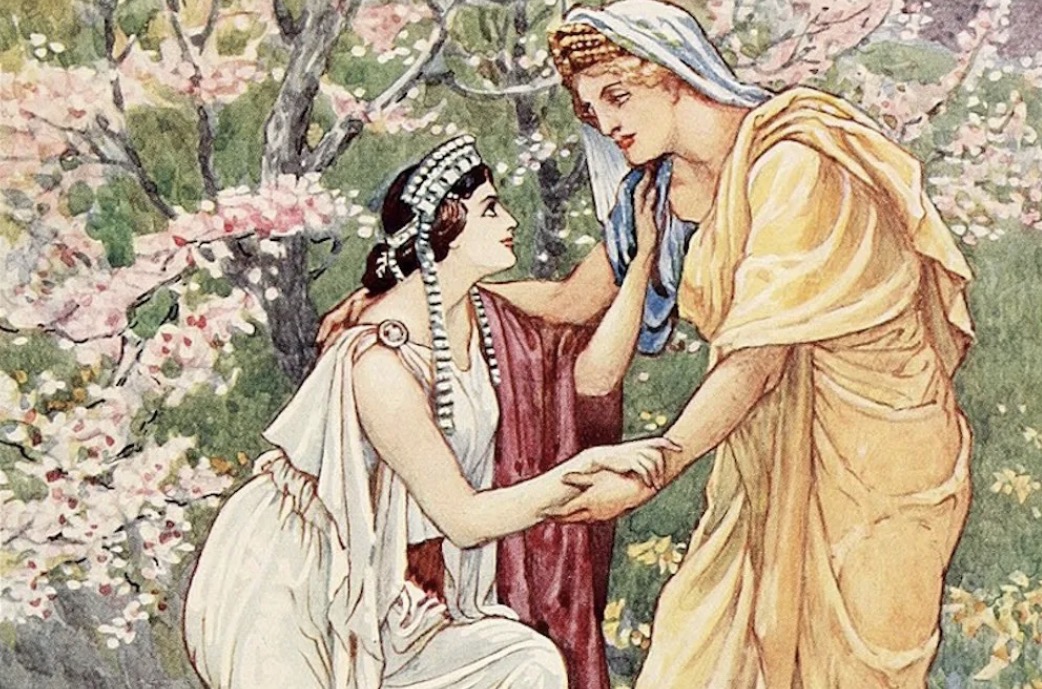
Photo: Demeter rejoiced, for her daughter was by her side by Walter Crane. From The story of Greece: told to boys and girls (1914) by Mary Macgregor. Courtesy of Public Domain.
Footnotes
- 95
- 227
- 4
- 230
 Intersections
