
Written by: Morgan Delva
Edited by: Abigail George
Horror media’s complex relationship with Black representation is well-documented, with tropes such as the ‘magical negro’ and the ‘Black person dies first’ being nearly synonymous with the genre. While these kinds of common tropes in the horror genre are often associated with Black men by default, the depictions of Black male expressions of fear are often less analyzed as unique forms of representation. They vary by subgenre, each of which provides unique on-screen depictions of its manifestations. However, the subgenre of ‘meta horror’ is distinctive in its self-reflective nature regarding common horror tropes. Meta horror has existed in some capacity nearly as long as horror itself, but it exploded in popularity in the 1990s and 2000s following the success of Scream in 1996. Thus, in any analysis of meta horror from this period onwards, an examination of the first Scream trilogy is essential to understanding the genre’s tendencies. Given its self-aware nature and commentary on various horror tropes, it is no surprise that the franchise has often reflected and/or critiqued the horror genre’s common depictions of Black men. This is specifically the case for Scream 2 and Scream 3, as the franchise’s first movie did not feature any named Black characters. These two Scream sequels each feature one Black male side character with plot relevance, namely Joel, the cameraman for news reporter Gale Weathers in Scream 2, and Tyson Fox, an in-universe actor in the fictional Stab franchise, which functions as a form of metacommentary on the Scream movies themselves.
When examining the role of these characters in the story and their behaviour throughout their respective movies, it is clear that they function as ‘audience surrogates’ who comment on the ridiculous or scary nature of the situations they find themselves in to a greater extent than the rest of the characters. It can be further argued that this is indicative of an overarching trend of filmmakers in this era potentially overcorrecting in the hopes of avoiding the embodiment of tropes such as ‘the Black man dies first’ as well as depictions of Black men as brutish and reckless. With this in mind, it is important to analyze both the ways in which the aforementioned Scream sequels–perhaps inadvertently–pioneered a new horror trope related to Black men, as well as the issues with this particular way of representing Black men on-screen.
Black Men as Audience Surrogates
The very nature of meta horror at large necessitates characters that act as audience surrogates, with the Scream franchise in particular containing a host of characters who are aware of horror movies’ typical narrative beats. The movies famously contain a multitude of scenes in which characters poke fun at the predictability of horror movies and the absurd decisions made by characters in them. However, before the franchise’s numerous revivals in the 2010s and 2020s, Black male characters in the Scream sequels were distinguished by a more potent kind of self-awareness. For instance, they would react incredulously to white characters putting themselves in danger and opting to escape potentially life-threatening situations. Furthermore, Black men in these movies frequently refer to their identity as a form of metacommentary on the genre, something that is not the case for white people in the Scream franchise. Rather, white characters focus on tropes related to general behaviours and decisions regardless of identity.
In Scream 2, Joel is a source of comedic relief through his constant panic amidst the unknown killer’s continued murder spree. This culminates in him deciding to exit the movie entirely after finding out that Gale’s last cameraman had been killed in the previous film. As Gale attempts to convince Joel to stay, initially succeeding by appealing to his desire for success in the journalism industry, he notably remarks: “Brothers don’t last long in situations like this.” This indicates his hyperawareness of the ‘Black man dies first’ trope in the horror genre, and it is this level of awareness that exacerbates his fear and desire to leave. Throughout the movie, Joel is also critical of his white entourage’s perceived recklessness, at one point telling his employer Gale that she “needs to have her head examined”. In addition, his discomfort with discussions of murder is played for laughs on multiple occasions, with him quipping to the movie’s main characters “I’m gonna get some donuts, some Prozac; see if I can find some crack, Special K, X… not Malcolm, and I’ll be back when y’all start talking about somethin’ a little more Saved By The Bell-ish.”
In Scream 3, Tyson, as mentioned earlier, plays a similar role as an ‘audience surrogate’. Throughout the movie, he is consistently one of the first to question other characters’ decisions. For instance, he tells his film director, Roman Reigns (who would eventually be revealed as the killer): “There’s a psycho killer on the loose and you wanna go traipsing around this gigantic mansion? Have you ever actually seen the Stab movies?” Despite his evident fear and questioning of his coworkers’ apparent aloofness in the face of danger, Tyson does not leave town like Joel did, which eventually leads to his death. He justifies his decision to his castmates by asking them, “You think serious Black actors my age can just throw away jobs? It’s all a business now.”
Lines like these function as a sort of inversion of Joel’s motivations, where Tyson justifies his continued presence in Scream 3 by pointing to his status as a Black man, while Joel points to his identity as a reason for him to leave in Scream 2. Despite this key difference, it is clear that Joel and Tyson both play the roles of a Black male side-character who is acutely aware of how his race impacts his role in the story. Due to this self-awareness, they are less inclined to investigate the killings or put themselves in danger through other means.
Overcorrecting?
The examples of Joel and Tyson in the above-mentioned Scream sequels are indicative of meta horror’s attempts to critique and distance itself from racist horror tropes through depictions of self-aware Black men who play a ‘straight-man’ role. In fact, Scream’s influence would lead to a plethora of movies satirizing the horror genre, many of which would play into the ‘Black man as an audience surrogate’ trope. Movies with Black leads or filmmakers would not be exempt from this trend. For instance, 2010’s paranormal spoof titled A Haunted House, starring and directed by Marlon Wayans, sees its main character, Malcolm, immediately attempt to sell his house and move upon discovering the presence of an evil spirit in his home. This exaggerated reaction embodies the trope of the Black man who, unlike many seemingly irrational white characters in the horror genre, refuses to put himself in danger recklessly.
However, the issue that lies in these attempts to subvert negative racist caricatures is that they are still rife with tokenization and essentialization of Black men, with Black male characters in meta horror often having their identities be a defining character trait and even the punchline to a joke that does not punch up. For example, Malcolm’s decision to move out is portrayed as cowardly and selfish in A Haunted House, with him leaving his girlfriend behind and implicitly stating that a Black man shouldn’t be crazy enough to stick around while a spirit haunts his home. Meanwhile, Scream 2 and Scream 3 also portray Joel and Tyson as cowardly, with them constantly attempting to back out of investigating murders while other characters press on and courageously attempt to catch the killer.
Whether intentionally or not, these representations imply that the characters in question are cowardly Black men who would rather abandon the people around them than face danger. While these characters’ cowardice is also used to poke fun at the white characters who recklessly put themselves in danger, the movies mentioned above lack the nuanced approach necessary to not inherently position Black men as those in the wrong. This is seen with other characters in the movies often playing a larger role in stopping the main threat. The pitfalls of Black male representation in the Scream franchise, in particular, are further seen by the fact that the franchise’s screenwriters still leaned into stereotypes of ‘brash’ Black men, with Tyson being described in Scream 3’s screenplay as “African-American, all attitude.”
Has Meta Horror Struck a Balance?
Despite its missteps in representing Black men, the Scream franchise, in some ways, succeeded in subverting the tropes it was criticizing. Joel and Tyson indeed did not die first, while also being apprehensive in dangerous situations rather than charging in recklessly. Furthermore, the franchise’s representations of Black people would develop more nuance and tact with the introduction of Mindy and Chad Meeks-Martin (the biracial children of Randy Meeks’s sister Martha) in Scream 5. Moreover, meta horror as a whole has evolved, with recent movies such as Jordan Peele’s Get Out (2017) providing more substantive satirical critiques of anti-Black racism in horror contexts without tokenizing or punching down on their Black characters. A key component of this shift is the increased presence of Black directors in Hollywood who draw on lived experiences when depicting and satirizing Black men’s reactions to scary events rather than attempting to represent them from an outside perspective. Of course, however, as seen in the case of movies like A Haunted House, merely having a Black director does not prevent films from playing into negative stereotypes of Black men.
Thus, while meta horror may have significantly evolved in recent years, the subgenre is not only still susceptible to negative stereotyping, but it is also beholden to the trends and tropes of the horror genre itself, given that it is built on satirizing and/or commenting on said tropes. This, along with the continued underrepresentation of Black filmmakers in horror, indicates that meta horror remains imperfect despite recent improvements.
Bibliography
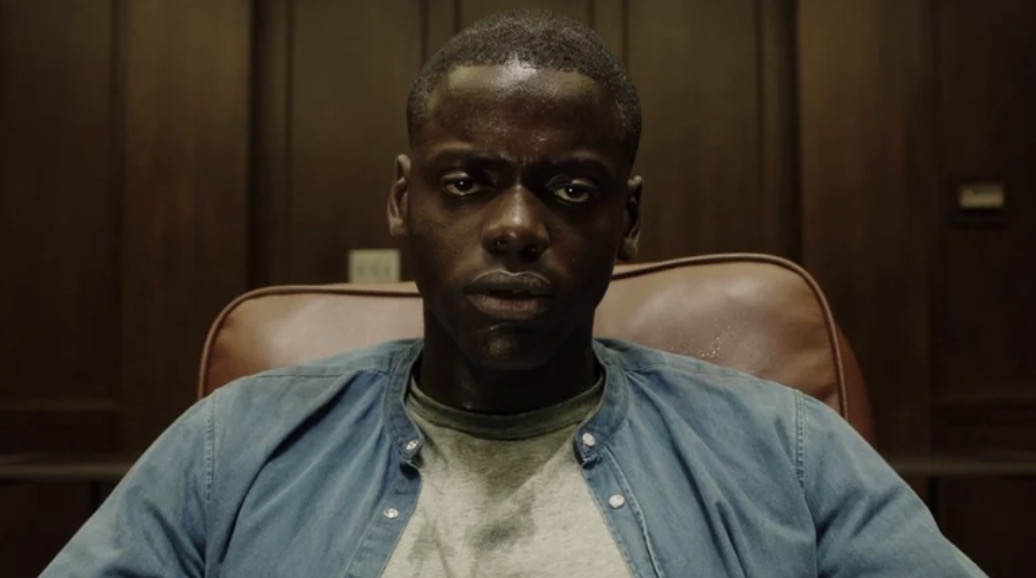
Photo: Universal Pictures. Film still from Get Out (dir. Jordan Peele, 2017). In Bee Delores, “The 15 Best Horror Movies From Black Directors,” SlashFilm, March 23 2022. https://www.slashfilm.com/807916/the-best-horror-movies-from-black-directors
Brown, Chloe, C. Shawn Conger, John Corum, Anthony Gross, Allison Langdon, Jaclyn Melcher, Mara Muccigrosso, Megan Serio, and Megan Skaggs. “We Are Not Who We Are: Metahorror’s Examination of Genre and Audience.” Edited by Collin Hammond, Jane Fife, Mary Ellen Miller, Walker Rutledge, and Judith Szerdahelyi. The Ashen Egg: A Journal of Undergraduate English Scholarship 3 (2015). https://www.wku.edu/english/pdf_files/ashen_egg_2015.pdf#page=51.
Buansari, Istihayyu, Maulani Pangestu, and Fariz Rakha Kans. “RACISM ASPECT IN GET OUT MOVIE DIRECTED BY JORDAN PEELE.” Pujangga 7, no. 1 (June 21, 2021): 43. https://doi.org/10.47313/pujangga.v7i1.1128.
Coleman, Robin R. Means. Horror noire, 2022. https://doi.org/10.4324/9781003168256.
IMDb. “Horror Noire: A History of Black Horror (2019) Documentary,” February 7, 2019. https://www.imdb.com/title/tt9567548/.
Indrusiak, Elaine Barros. “It’s about taking the formula and modernizing it : a study of Scream (1996) and Scream (2022),” 2024. https://lume.ufrgs.br/handle/10183/293086.
Jackson, Kimberly. “Metahorror and simulation in the Scream series and The Cabin in the Woods.” In Palgrave Macmillan US eBooks, 11–30, 2013. https://doi.org/10.1057/9781137360267_2.
Larman, Alexander. “The Rise of Meta-Horror.” The Critic Magazine. January 16, 2022. https://thecritic.co.uk/the-rise-of-meta-horror/.
Frieze. “Unmasking Hollywood horror’s racial stereotypes,” October 14, 2025. https://www.frieze.com/article/unmasking-hollywood-horrors-racial-stereotypes.
Wiki, Contributors to Scream. “Joel.” Scream Wiki, n.d. https://scream.fandom.com/wiki/Joel#Quotes.
Wiki, Contributors to Scream. “Reporter with Mask.” Scream Wiki, n.d. https://scream.fandom.com/wiki/Reporter_with_Mask#:~:text=Portrayed%20by,Black%20characters%20until%20Scream%202.
Wiki, Contributors to Scream. “Tyson Fox.” Scream Wiki, n.d. https://scream.fandom.com/wiki/Tyson_Fox.
 Intersections