
Written By Colin Parker Griffiths
Edited By Hannah MacDonald
Introduction
During the nineteenth century, a significant trend among male European artists was the creation of Orientalist paintings. This catalog of paintings greatly contributed to the European social imagination of the “East,” and worked to cultivate a shared perception of Islamic regimes as exotic and inferior. Orientalist art was thus used to manipulate the Western consciousness and served as a political method of control to instill demoralizing ideas of Muslim societies and further justify public support for European colonial expansion (Kahf 8). Before the creation of digital media and photography, paintings played an integral role in establishing the occidental audience’s false perceptions of other regimes. Western artists would often violently essentialize other cultures within their artwork by drawing upon their imaginative and stereotypical interpretations of said cultures. Considering that these artworks would reach a wide audience of the Western populace while being displayed in reputable galleries and museums, these skewed misrepresentations became the primary informants of Europeans’ impressions and beliefs about different cultural contexts (Nochlin 38).
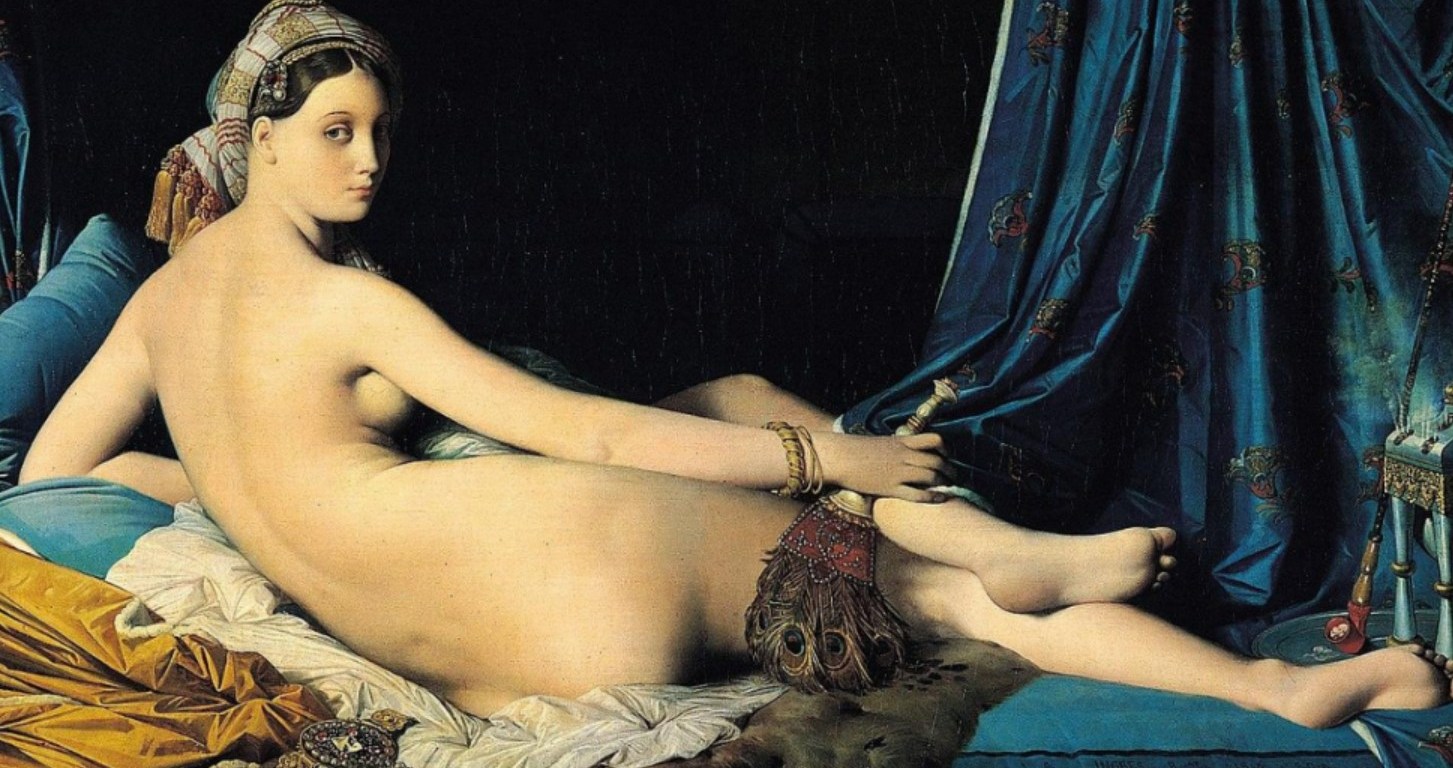
The oil painting La Grande Odalisque (1814) by Jean Auguste Dominique Ingres is one of the most famous paintings in this catalog of Orientalist art produced in Europe and remains on display at the Louvre Museum in Paris today. With the development of the contemporary field of Orientalist studies, La Grande Odalisque has received a significant amount of criticism and scrutiny, as Ingres—a most remarkable and influential figure in the art world—reinforced sexist and xenophobic stereotypes through his illustration of a Muslim woman (Ockman 187). Ingres made intentional decisions within the formal properties of this painting to represent Muslim women as sexually primitive by nature, while simultaneously oppressed by male authority because of their alleged libidinous inclination. He prescribes the Muslim woman he painted with the stereotype of the lustful “Odalisque” that emerged in the early nineteenth century: a denigrating visual trope of Muslim women who are often painted fully nude and ‘imprisoned’ inside their private domestic space known as the harem within Muslim culture. The Odalisque, as a vilifying artistic and ideological archetype, was a device employed to universalize Muslim women as sexually perverse and lacking agency, all while contributing to the larger damaging rhetoric regarding the alleged “corruption” of Islamic regimes—a rhetoric that evidently continues to be mobilized today in Western political discourse (Fay 35).
Conducting a feminist art-historical analysis of La Grande Odalisque and relating it to Western contemporary political discourse of Islamic cultures proves a pragmatic way of investigating how stereotypes of Muslim women have transformed over time. More specifically, this praxis illuminates how tropes of Muslim women have long remained fixed at the forefront of Western colonial and imperial agendas to entrench a violent framing of Islamic culture into the collective Western consciousness, ultimately working to reinforce the ideological divide between the Occident and the Orient.
Formal and Historical Analysis of La Grande Odalisque
In La Grande Odalisque, Ingres employs his white male gaze as a controlling political tactic. Rather than including a male subject within the painting, he figuratively inserts a phallic male intrusion into this woman’s private space by positioning the audience of this painting as voyeurs of the Odalisque. In doing so, Ingres caters to European men’s sexual desire and denigrating cultural fascination of the so-called “exotic land.” He paints this woman horizontally reclined on her bed, with her body turned away from the viewer in a closed, static position that suggests a timidness through her body language. However, her piercing returned gaze to her preceptor insinuates otherwise. She is presented as a passive yet sexually seductive Muslim woman inside the harem, which Ingres exoticizes through its decor: luxurious embroidered fabrics, a smoking pipe, and a jeweled medallion strewn in the sheets. Important to Orientalist paintings were the misguided Western conceptions of the harem, which were entirely based on male fantasy and did not acknowledge the realities of Islamic culture. The harem is not a space that women are confined to in order to subdue them, but is rather a sacred feminine space that men cannot enter (Khaf 6; Fay 34). Furthermore, Ingres creates a sense of spatial ambiguity by employing a chiaroscuro lighting arrangement; the background is nothing but a dark void that works to erase both her and the harem from time, space, and the cultural context in which she lives. In doing so, Ingres attempts to redefine the category of Muslim women in the very moment he paints.
In much of European art history, the representation of the female sexed body within art was limited to figures of goddesses and subjects of classical antiquity, such as Venus or Aphrodite. Up until the end of the twentieth century, it was only under these circumstances that representations of female nudity within art were socially acceptable (Nead 5-6). If the female nude was artistically represented as a human instead of as a mythological figure, she would often be represented as a sex worker inside the brothel. These representations of female sex workers were significantly common among male artists during the nineteenth century when misogynistic anxieties around sex work were prevalent, as seen in the famous works Olympia (1863) by Édouard Manet and The Sleepers (1866) by Gustave Courbet (Kerley 30). Such paintings by Ingres’ later French contemporaries were created with the intention of inflicting shame upon women who engaged in sex work or to mediate their masculine desire and revulsion for women’s bodies. The European bourgeoisie of the nineteenth century believed that female sex workers exhibited extremely immoral and unhygienic representations of femininity, and thus, sex work was at the forefront of a prolonged, sexist discourse as the general consensus was that these transgressive displays of femininity were allegedly responsible for all disruption in society (Kerley 120-121). In creating shameful representations of female sexuality and idealizing the epitome of a ‘grotesque’ woman, these artworks worked to establish a socially shared understanding of what were considered ‘respectable’ representations of femininity for white women in Europe.
What makes La Grande Odalisque different from these paintings of nude European women, despite the continued theme of female nudity, is the fact that the Odalisque is not a sex worker, nor is she painted inside of the brothel. Interestingly, this painting insinuates that her private domestic space is left open for men to commodify and consume her nude body. The painting thus implies that Muslim women are sexually transgressive and immoral in comparison to European women, whose feminine respectability was primarily defined by their virgin purity and values of celibacy (Ockman 195). When acknowledging the agenda behind La Grande Odalisque, it is unsurprising that the work was commissioned by Caroline Murat—the Queen of Naples and Sicily and the younger sister of Napoleon whose interest in the “exotic East” led him to invade Egypt at the end of the seventeenth century (Ockman 187). The fact that this painting was commissioned for the private collection of a female French aristocrat, despite the existing taboos around female sexuality, illuminates how sexually primitive images of Muslim women were a means for upper-class, white European women to define themselves as respectable women by defining exactly what kind of women they were not (Ockman 194). This one-sided authoritative relationship in which European women define themselves as distinct from Muslim women is rather reflective of the broader model in which the West defines itself as politically and culturally superior to the Orient.
Tracing the Developments of Muslim Stereotypes in Contemporary Political Discourse
Before Islam emerged on the world stage, “the West ” as a distinct regional and political identity did not exist (Kahf 2). Once the Middle East became a subject of colonial curiosity, Western narratives of Islamic regimes began to portray Muslim women as victims of oppression, likening them to “harem slaves” imprisoned by their religion, fathers, and husbands (Khaf 9). This framing was not conceived with the intention of liberating Muslim women but was instead utilized to subdue them by comparing them to Western women. The true intention behind this rhetorical framing was to reveal Muslim women’s perceived shortcomings in embodying the ‘modern’ and ‘respectable’ forms of femininity that were socially constructed by the European bourgeoisie. (Khaf 4). These harmful stereotypes of Muslim women, alongside the West’s creation of the “Islamic Other,” were both means of garnering public support for the ‘heroically male’ colonial expansion and domination of foreign lands—a project that crucially depended on marking Islamic culture as inferior (Kahf 7-8).
Within contemporary Western discourse regarding the “War on Terrorism,” the rhetoric of “saving Muslim women” is continually used to justify imperial intervention in Islamic regimes (Abu-Lughod 783). This rhetoric is fueled by this same superiority complex that arose from Western stereotypes created of Muslim societies and the status of Muslim women, which date back to the late seventeenth century. Such discourse surrounding “saving Muslim women” in contemporary Western politics continually seeks to critically examine the status of women in Islamic regimes (although in an irresponsible and essentializing manner) using religious and cultural modes of explanation (Abu-Lughod 784). Solely drawing on these religious and cultural modes of explanation in an attempt to theorize the status of Muslim women sustains a specific colonial narrative, one that intentionally evades truth by remaining reluctant to reflect on the historical and political situatedness of Muslim women. If these contexts were considered within such discourse, it would reveal the violently arbitrary, globally interconnected relationship between Islamic regimes and Western colonial states. This relationship has ultimately played a significant role in the development of repressive regimes throughout history (Abu-Lughod 783, 787). In doing so, this tactic continues to shape the Western collective imagination of Islam, ideologically dividing the world into separate spheres. As the former First Lady of the United States, Laura Bush, negligently described in her 2001 speech, this divide between the Orient and the Occident is characterized as “cultures in which First Ladies give speeches versus others where women shuffle around silently in burqas” (Abu-Lughod 784). The continued perpetuation of these colonial narratives and the political mobilization of the status of Muslim women serves to gather Western agreement for imperial intervention in Middle Eastern countries, proclaiming that such intervention will offer Muslim women the same alleged liberation experienced by women in the Western ‘freedom land.’ Ultimately, this rhetoric demonstrates how ill-drawn comparisons between the lives and circumstances of Western and Muslim women continue to be a primary device used to establish political and cultural dominance.
Conclusion
The Odalisque trope misrepresents the ideology of the harem while simultaneously mobilizing Muslim women’s sexuality, framing this space as sexually imprisoning and oppressive despite its religious importance and value for Muslim women (Kahf 6). Similarly, the “saving Muslim women” rhetoric undergoes the same process, focusing heavily on how the burqa and the veil are dehumanizing methods of misogynistic control, even while many Muslim women consider veiling as a respectable and empowering act of modesty that represents their devotion to their families (Abu-Lughod 785-786). As such rhetoric fails to recognize Muslim women’s circumstances, values, and beliefs, it attempts to remove them from the true social, political, and historical contexts in which they live, much like Ingres does in his painting. In both the Odalisque trope and in this Western contemporary rhetoric of “saving Muslim women,” the focus is narrowed to the idea that Muslim women are innately oppressed. They are interconnected tactical methods of control that intend to naturalize a specific Western imagination of Muslim women that sees them as a uniform, timeless category of people who are in desperate need of salvation. Both these tropes and stereotypes are products of the heterosexual male perspective that is integral to Western values of colonial and material domination (Khaf 176-177). They work together to deceivingly frame Western military operations in Islamic regimes as a heroic good deed for women’s justice when, in reality, it is a symbolic veil to cover the true intention of subjugating Islamic culture by framing Muslim women as victims.
Bibliography
Abu-Lughod, Lila. “Do Muslim Women Really Need Saving? Anthropological Reflections on Cultural Relativism and Its Others.” American Anthropologist, vol. 104, no. 3, 2002, pp. 783–790.
Fay, Mary Ann. “Reimagining the Harem: From Orientalist Fantasies to Historical Reconstruction.” Unveiling the Harem: Elite Women and the Paradox of Seclusion in Eighteenth-Century Cairo. Syracuse, Syracuse University Press, 2012, pp. 23–44.
Kerley, Lela F. Uncovering Paris: Scandals and Nude Spectacles in the Belle Époque. Louisiana, Louisiana State University Press, 2017.
Khaf, Mohja. Western Representations of the Muslim Woman: From Termagant to Odalisque. New York, University of Texas Press, 2002.
Nead, Lynda. “Framing the Female Body.” Female Nude: Art, Obscenity and Sexuality. London, Routledge, 1992, pp. 5–12.
Nochlin, Linda. The Politics of Vision: Essays on Nineteenth-Century Art and Society. 1st ed., New York, Routledge, 1989.
Ockman, Carol. “A Woman’s Pleasure: Ingres’s La Grande Odalisque.” Reclaiming Female Agency: Feminist Art History after Postmodernism, edited by Norma Broude and Mary Garrard, California, University of California Press, 2005, pp. 187–203.
 Intersections