
Written By Andrea Oraka
Edited By Kaileigh-Anne Grnak and Lauren Bullock
Note: This piece is an excerpt from a longer piece with several chapters written by the author, however given the uniqueness of the piece and its relevancy to this month’s theme we decided to feature only the introductory chapter given the journal’s writing constraints.
The future and the possibilities promised by science fiction media are vast and diverse, ranging from flying cars to spatial travel. However, all these futures hinge on the narrative that whatever you dream, you can achieve through the power of technology. Such an understanding of tech places the interests of the creator and user as paramount- things are created for you and your needs. This philosophy complicates the ubiquitous presence of female sex robots in science fiction films, T.V, and culture, as it raises the following questions: for whom is the sex robot created, what fantasies do these robots fulfill, and what desires do they embody? Why is it that men, more so than women, are eager for the arrival of the future when such technology is readily available? In the age of technochauvinism, in which tech is always believed to be the solution (Broussard, 2018, p. 7-8), sex robots are deposited as a solution for male sexual fantasies, and in doing so, they emulate and transform human-to-human sexual and intimate relationships. Existing academic literature on sex robots narrowly focuses on their appearance and the use for sex. I aim to articulate a nuanced theoretical understanding of these two points, reconceptualizing what exactly is a sex robot into three key points: it “becomes” human, it can only be gendered (understood and designed as a “woman” in which woman reflects a specific patriarchal identity), and these robots have “agency”. This short paper concludes on a central concern raised by the existence of sex robots, that their reliance on patriarchal desires and constructions of heterosexuality transforms human-to-human sexual and intimate relationships in ways that concretely harm women.
Conventional sex technology, i.e.: sex dolls, differ from the sex robots that are the subject of science fiction media and academic philosophical, feminist and technological theories. These theories engage with the sex robot as beyond the inanimate, instead conceiving them as complex vessels with technological capabilities. This paper carefully choses the word “vessel” — defined in the Webster dictionary as meaning both an object to hold and a person representing a unique quality— to describe the sex robot in order to properly capture its dual realities, it is an object and a person. While existing sex robots do not possess the range of animation of those we see in sci-fis, they have adequately obtained human likeness and responsiveness, possessing motors capable of facial changes, vocal dialogue, tactile sensors in erogenous zones and “sexual organs” (Johnson, 2020, p. 419). These anthropomorphic humanoid vessels are responsive and utilize interactive AI to emulate and heighten the intimate and sexual experience of their users. Thereby establishing a sort of seamlessness with reality. They kind of look and act like how a woman “should”, and thus they blend in smoothly within our conventional imaginary. This ability to look or act human informs the technological and theoretical importance of sex robots. By emulating human actions and physiology these robots test one’s ability to separate the technological from the biological- however, not in the sense that we cannot recognize a robot when we see one. Rather it is by looking and acting like us that the emotive potential to bond with robots like we bond with each other grows. We can begin to see (and therefore treat) the sex robot as a person. By virtue of its goal of intimacy and sexuality, which informs its aforementioned technological abilities (a human likeness and responsiveness), the sex robot is defined predominantly by its ability to feel and therefore be “human”.
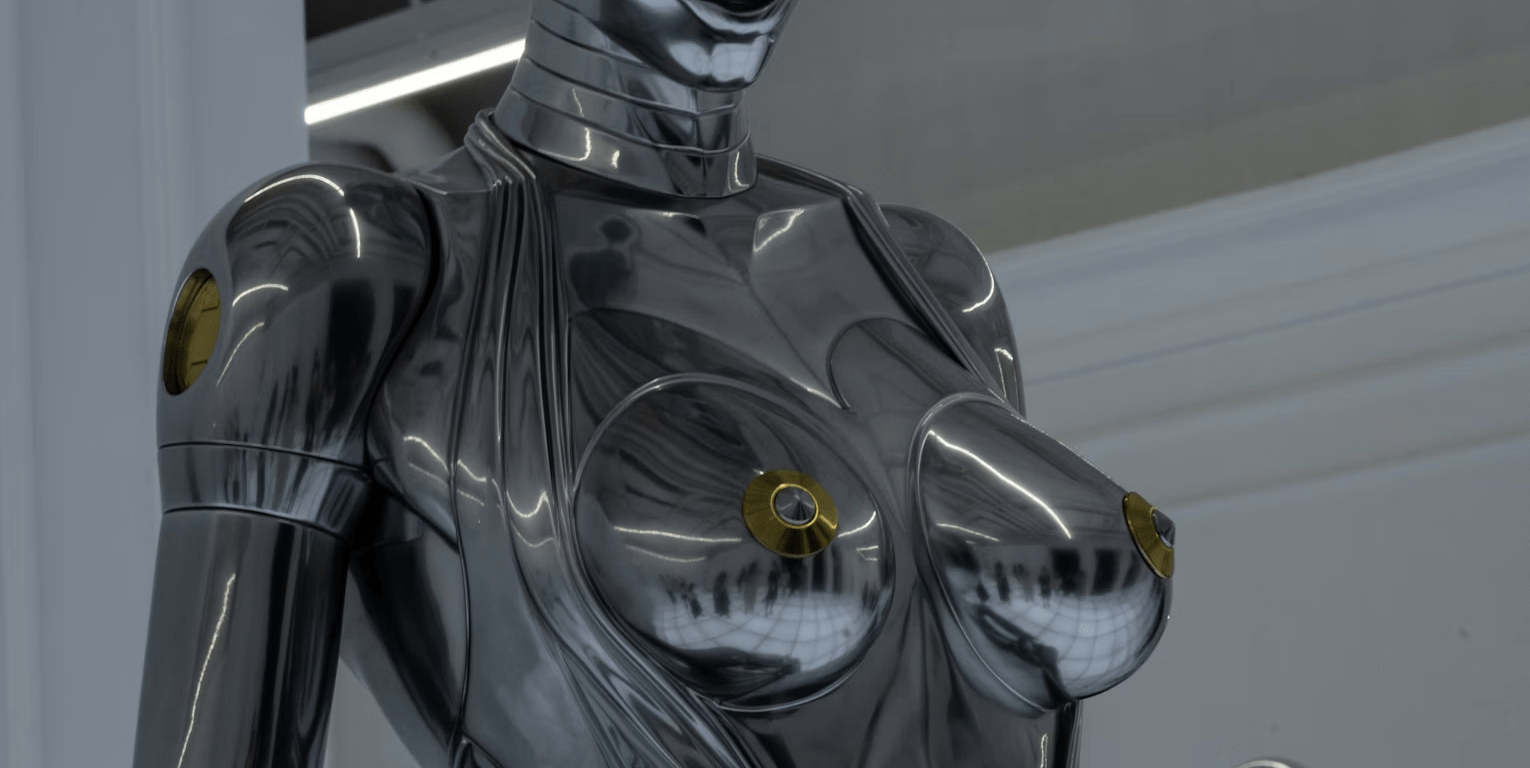
In order to properly serve the heterosexual male desires it is designed for, and fulfill its sexual and intimate objectives, the sex robot doesn’t only need to feel/become human, it must also become a “woman”. This introduces the second characteristic of the sex robot, its heavily gendered nature. Sex robots in predominant sci-fi depictions and theorizing are women made for the sexual desires of their male owners. They embody “heteronormative relationships and gender roles so that the humanoid female robots can serve as sex objects for heterosexual male humans” (Döring, 2019 p. 8). This gendered aspect informs the customization possibilities of the sex robot because it must embody the idealized male vision of a “woman” through its appearance. In other words, these robots must look like women men would want to have sex with. In this regard, the customization of sex robots is limited in so far as they remain “attractive” in the eyes of the users, therefore highlighting that how these robots look is not simply a product of the creator’s individual aesthetics but rather reflect notions of desirability and the idealized presentations of femininity and womanhood. Existing sex robots embody an essentialist and male-driven notion of the desirable female body; petite and skinny with a small waist, curvaceous with a large bust and hips, and often white (Su, 2019, p. 11). The one area in which their customization transforms the source material (human women) and deploys creativity and uniqueness, is to further accentuate areas of male sexual gratification. The hips, breast and waist ratio of current sex robots are not anatomically possible for a human woman, but this customization makes the robot desirable. This characteristic of sexual attractiveness as constituting the customization of feminized sex robots is a shackle that limits the potential representation of women that sex robots can embody. In Futurama, a show that depicts a future in which humans and robots coexist, Bender’s appearance, while retaining a humanoid frame, is unique in ways that the Liubot—an intimacy robot in the image of the actress Lucy Liu — is not (Futurama, 2001, S3 EP.15). While male robots in the show come in many forms and expressions (for instance, Hedonismbot has six arms and walks on all fours) the female robots designed for intimacy and are pined after as sexual and emotional partners are relegated to a singular gendered conception. Even in science fiction, a genre that is defined by its ability to transcend the normative, female sex robots must exist in a stereotypical sexualized body.
Finally, a core value of the sex robot as a solution for the gratification of male sexualities is the fact that their affection never wanes—they are continuously committed, available, and attracted to their owner. While these robots are programmed to reciprocate desire, they do not desire, as they do not possess the agency necessary to do so. Yet, in science fiction media, such as the 2017 movie “HER”, an artificial agency is created in the sex robot (in the case of HER, AI), that is perceived and felt by the users of such technology. Imagining that their affections for the robots and AI is not one-sided, that the robots want to have sex and be intimate with their “owners” as much as their owners want to have sex and be intimate with them. Academic research has showcased that this artificial agency of a reciprocal relationship between user and sex robot is not simply fictive but occurs in reality. Such as Belinda Middleweek’s 2007 qualtative study on male sex doll communities and how they express and enact their sexual and emotional desires and preferences through their relationship with their sex dolls. Respondent’s statements such as: “I had dinner with Harmony (read: sex doll) at the table today, and we talked a lot getting to know each other,” and “She seems to be enjoying herself”. These quotes reaffirm the aforementioned desire that exists in owners of such sex technologies to build a reciprocal relationship rooted in an artificial agency. This desire and the corresponding notion of artificial agency it creates, stems from the personification of the sex robot and its technological aim and success of making its user desire/be able to relate with the robot in an emotional and sexual capacity. Thus a sex robot that has achieved its goal of being/feeling like a human woman, one in which sexual and emotional connections and relationships are possible to envision and desire, is also a sex robot that seems agentic but actually isn’t. This faux agency is problematic because the sex robot cannot say “no” and it exists solely to reaffirm male sexuality and reinforce male pleasure. Thus, agency as a characteristic of sex robots, despite attempts by science fiction to view this as the humanization of the robot, is simply another reflection of sex robots being tailored to the desires of their owners. Agency furthers the issue of the sex robot raised by the previous two characteristics, the focus on creating an entity to please men is built on a conception of “woman”, inanimate and real, that further entrenches misogynistic desires of what women should look like and act like in a heterosexual relationship.
References
Broussard, Meredith. Artificial Unintelligence: How Computers Misunderstand the World, MIT Press, 2018. ProQuest Ebook Central, https://ebookcentral.proquest.com/lib/mcgill/detail.action?docID=5355856.
Doring, Nicola, and Sandra Poeschl. “Love and Sex with Robots: A Content Analysis of Media Representations”. International Journal of Social Robotics, vol. 11, no. 4, Aug. 2019, pp. 665-77, https://doi.org/10.1007/s12369-019-00517-y
Johnson, Deborah G., and Mario Verdicchio. ‘Constructing the Meaning of Humanoid Sex Robots’. International Journal of Social Robotics, Vol. 12, no. 2, May 2020, pp. 415-24, https://doi.org/10.1007/12369-019-00586-z.
Middleweek, Belinda. Male Homosocial Bonds and Perceptions of Human-Robot Relationships in an Online Sex Doll Forum’. Sexualities, vol. 24, no. 3, Mar. 2021, pp. 370-87, https://doi.org/10.1177/1363460720932383.
Purdum, J. (Director). (2001, May 13). I dated a robot (Season 3, episode 15). In Futurama. Fox. https://www.imdb.com/title/tt0584443/?ref_=ext_shr_lnkSu, Norman Makoto, et al. ‘Of Dolls and Men: Anticipating Sexual Intimacy with Robots’. ACM Transactions on Computer-Human Interaction, vol. 26, no. 3, May 2019, p. 13:1-13:35. ACM Digital Library, https://doi.org/10.1145/3301422.
 Intersections