
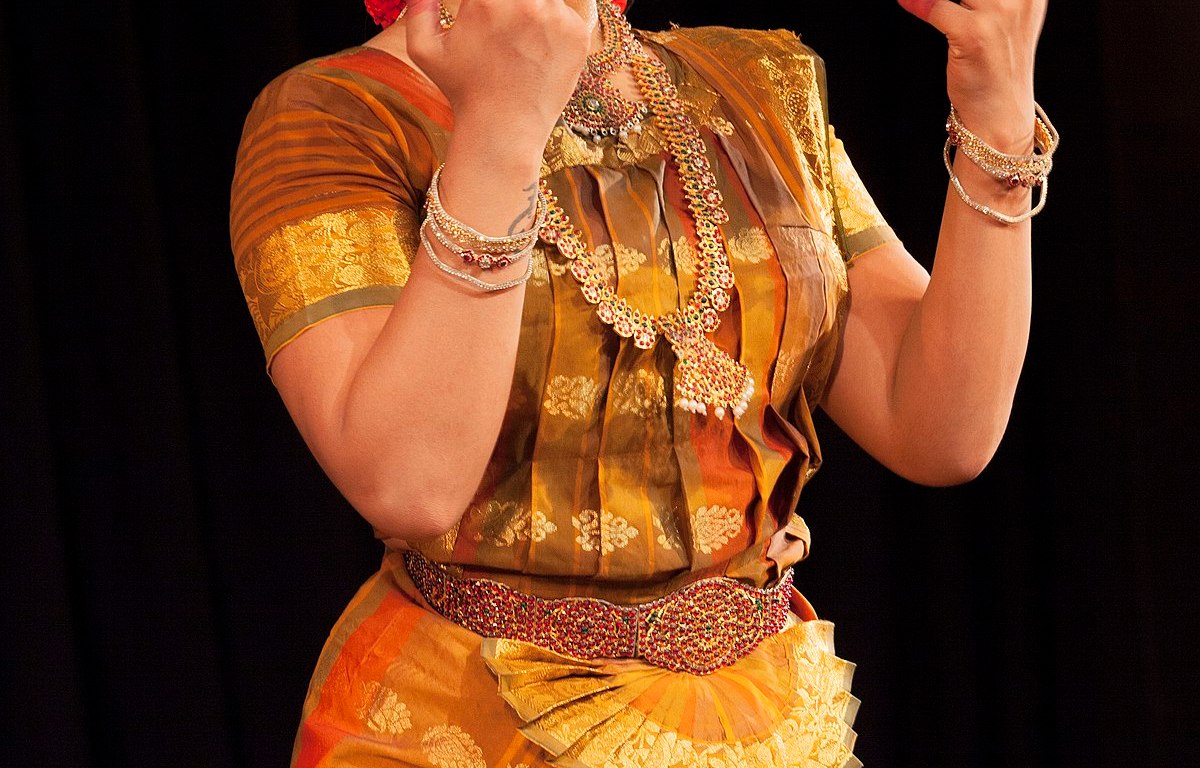
Written By Purva Vyas
Edited By Jayda Smith
Art forms such as dance and music are inherently political, as they represent the social and philosophical context in which they were created. One of these art forms is Bharatanatyam, an Indian classical dance style that originated in Tamil Nadu in approximately 300 BCE. Bharatanatyam, originally known as Sadir, among other names, was first practiced by professional dancers known as Devadasis within the precinct of the Hindu temple. However, during the tumultuous colonial and post-colonial eras, Indian social realities underwent significant transformations, particularly in regards to the social position of women. As a result of the project undertaken by post-colonial Indian nationalists surrounding the moral construction of the ideal Indian woman, Sadir too underwent remarkable changes in regard to its tradition and practices. I argue that the post-independence nationalist project appropriated the art of Sadir to become a characteristic of the moral, Sanskritised woman, thereby ostracizing the Devadasis who had preserved the art for centuries. I will begin by providing the context of the post-colonial construction of womanhood in India and an overview of the history of Bharatanatyam and the Devadasi tradition. Then, I will provide an analysis of how Indian nationalists utilized Bharatanatyam to construct the ideal “new woman” of India and the consequences this had for the Devadasi community.
To understand the role Bharatanatyam played in the nationalist reconstruction of womanhood, it is important to analyze what this reconstruction involved. In post-colonial India, the reconfigured standards for women regulated women’s behaviour through social and cultural norms which included the gendered division of labor. This reconfiguration of gender roles and the contribution it made to the development of the post-colonial Indian nation-state is a case of essentialized womanhood. The essentialization of gender refers to the act of the state manipulating gender roles and standards and embedding them into the cultural fabric of the state in order to effectively exert control over their populations. Post-colonial Indian social reform considered the construction of Indian women’s gender identity to be a response to colonial criticisms of the status of women in pre-colonial society. These post-colonial nationalist projects were developed around the separation of Indian culture into two spheres: material and spiritual. Justifications for colonialism were predicated on the assumed superiority of Western civilization in the material sphere. In order to overcome Western domination, Indian nationalists believed they needed to learn the “superior” material techniques of the British in the fields of science, technology, economics, and statecraft (Chatterjee 623). However, the nationalists also recognized that integrating Western values into all aspects of Indian life would result in the destruction of Indian culture and identity. Therefore, they focused on preserving the spiritual essence of Indian culture that was rooted in Hindu traditions. By incorporating the material techniques of the Europeans with the spiritual tradition of India, Indian nationalists were able to develop the idea of a “new woman” who was superior to lower-class women, Western women, and Indian women from preceding generations (Chatterjee 622). The goal of the nationalist project was to maintain the spiritual essence of pre-colonial Indian society while modernizing the material sphere through Western colonial techniques. To do so, political elites manipulated gender roles by attributing the two spheres, spiritual and material, to women and men respectively. Therefore, it was crucial to the nationalist cause that women and men maintained their distinct roles in society. While men handled responsibilities related to the material world, the “new women” held a spiritual responsibility directly tied to the historical goal of sovereign statehood. In other words, they were responsible for maintaining the spiritual core of Indian society (Mathur 99). Although the more flexible boundaries in the new imagining of womanhood allowed women to enter the world outside the home, this was only permitted up to the point where their femininity was not threatened. This new patriarchy, rather than freeing women completely, simply subjected them to a reimagined and manipulated form of legitimate subordination (Chatterjee 629). However, the manipulation of cultural and social norms by nationalists motivated women to subscribe to this new form of womanhood. Proximity to the new conception of womanhood provided Indian women with a sense of cultural superiority over women who did not subscribe to the socially constructed norms. With this, the new patriarchy’s weaponization of “coercive authority with the subtle force of persuasion” to exercise dominance over the female population of India becomes evident (630). Women’s belief that they could achieve their own freedom by adhering to social norms strengthened nationalistic ideologies (627). Indian nationalists used the essentialization of culture to assert their sovereign nationhood. They manipulated gender identity and utilized newly constructed cultural norms to assert control over women in order to further their nationalist project. The women who subscribed to the notions of “new womanhood” were distinguished from the others in terms of “national identity, social emancipation, and cultural refinement” (Chatterjee 629). The women who deviated from the acceptable norm were ostracized and excluded not only by men but also by women who now considered themselves to be superior.
The dance of Sadir traces its roots to the Natya Shastra, an ancient script written by the sage Bharatha-Muni. The Devadasis who practiced this art danced the stories of God inside the temple and performed ritual oblations. She was dedicated to the temple and was often formally “married” to the deities, preventing her from marrying a mortal man. She could, however, engage in sexual relations with a king or priest (Meduri 4). At the height of her prestige, the Devadasi was considered a jewel of both the king’s court and temple, balancing her patronage with her personal independence (Meduri 4). The Devadasi stood in a particularly unique social position in that she existed outside of both the caste system and the role of motherhood. The Devadasi community consisted of a matrilineal kinship, but they did allow any member of society of any caste to send their children to the system to join the community, allowing them to gain mobility. Therefore, they possessed a certain degree of social mobility and a certain non-exclusivity within their community (Ganesh 117). The process of becoming a Devadasi included many years of training. However, once they became professional, they were on the payroll of the temple or court, earning a living from endowments. Their position as a Devadasi allowed them to educate themselves and hold property (Ganesh 117-8). The tradition of the Devadasis continued up until the 18th and 19th century, but the commitment was slowly decreasing (Meduri 4).
During the Indian freedom struggle against the British in the early 20th century, the Indian population was discussing the morality of the female performing class. Included in these debates were discussions about ‘cleansing’ society of prostitution and ‘licentious women’ (Ganesh 118). As a result, the Devadasi community became the focus of many political agendas, specifically surrounding issues of female morality. In Brahmanical patriarchal society, the policing of female sexuality and morality has been a crucial point of discussion, as it was in the case of the Devadasi (Kang 206). Public disapproval toward the Devadasi and her tradition became commonplace. This disapproval was targeted toward her availability to those who visited the temples, as the South Indian ‘sense of decorum’ believed in the synchronization of inner purity with outer action. This meant that they disagreed with the Devadasi’s ability to dance in front of God by day and engage in the “mortal delights of humans” by night (Meduri 6). Thus, Indian society enacted laws abolishing temple dancing, appropriating the dance from the traditional patrons.
Following these developments, the art of Sadir was taken from the Devadasi community and given to upper-class ‘respectable’ women. The Prevention of Dedication Act of 1947 legalized marriage for Devadasi women and prevented girls from being dedicated to temples as they would have been to become Devadasis in the past. In the face of this Act, women belonging to the upper and middle-classes chose to adopt Sadir without dancing for wages, but rather just as a form of social enhancement (Ganesh 119). This shift from Sadir as a method of earning wages to a method of social enhancement allowed the patriarchal system to bestow this dance upon the ‘respectable’ woman who did not consider it a livelihood. The male members of the community continued the art of Sadir by becoming the teachers of Sadir for these new, non-hereditary dancers (119). Around the 1950s, the name was officially changed from Sadir to Bharatanatyam. Using a new name and including it in a national social-reform project diminished the Devadasi female hereditary privilege and occupation. This then established Bharatanatyam as a new cultural heritage for upper-class women (119). This name change was a calculated move directed toward the disenfranchisement of the community of women who had been preserving this dance form for many centuries (120). Although no significant changes were made to the content of the dance, the dancer’s body became an object. The patriarchal gaze of Indian society viewed Bharatanatyam as a form of social enhancement when performed by the bodies of upper-class women while viewing it as immoral when performed by the body of the Devadasi (121).
The construction of womanhood by Indian nationalists was closely related to the gradual adoption of certain Christian values through colonialism. The British-educated middle-class of India began to question the conjunction of the ‘sacred’ and the ‘profane’ that the Devadasis seemed to embody and soon considered them to be prostitutes. The Hindu-ization project of the nationalist movement brought with it the need for purity among women, therefore emphasizing the desexualization of the Indian female image, and religion was pinpointed as the mechanism through which this would be accomplished (Mitra 74). Within many societies, women have been characterized as the spiritual center of the community. Consequently, a woman’s identity becomes synonymous with the morality and religiosity of her society. Indian women became the symbols of culture and Hinduism, as seen through the revival of classical dance and the construction of the ideal Indian woman (Chakravorty 112). Within this image of the spiritual, moral, chaste Indian woman, the sexual liberation and empowerment of the Devadasi community was considered a threat to the nation (Mitra 74). However, these ideas of purification led the nationalists back to the ‘spiritual roots’ of India, which they believed lay in the regeneration of Vedic arts, dance, and music. As a result, while the Devadasis were characterized as sinful and immoral, their art was revived as the pinnacle of spirituality. Through this, the history of Sadir was rewritten to exclude the community of dancers who had originated it. The Devadasi community was ostracized, discriminated against, and their history was erased from the story of Sadir. Many of them were forced into prostitution due to a lack of alternative means of livelihood (Chakravorty 113).
The nationalist project appropriated Indian classical dance to construct the ideal moral and spiritual Indian woman. This nationalist project was influenced by Christian, colonialist ideas and applied these values to Indian society. In doing so, the Devadasis who had preserved the art of Sadir were disenfranchised from their livelihoods and their role in the art form was erased.
Works Cited
Chakravorty, Pallabi. “From Interculturalism to Historicism: Reflections on Classical Indian
Dance.” Dance Research Journal, vol. 32, no. 2, 2000, pp. 108–19. JSTOR,
https://doi.org/10.2307/1477983. Accessed 7 Apr. 2023.
Chatterjee, Partha. 1989. “Colonialism, Nationalism, and Colonized Women: The Contest in
India.” American Ethnologist 16(14): 622-633.
GANESH, SWARNAMALYA. “RENAMING ‘SADIR’ AS BHARATANATYAM: What’s in a
Name?” India International Centre Quarterly, vol. 42, no. 2, 2015, pp. 116–25. JSTOR,
http://www.jstor.org/stable/26316557. Accessed 6 Apr. 2023.
Mathur, Saloni. “History and Anthropology in South Asia: Rethinking the Archive.” Annual
Review of Anthropology, vol. 29, 2000, pp. 89–106. JSTOR,
http://www.jstor.org/stable/223416. Accessed 14 Apr. 2023.
Meduri, Avanthi. “Bharatha Natyam-What Are You?” Asian Theatre Journal, vol. 5, no. 1, 1988,
pp. 1–22. JSTOR, https://doi.org/10.2307/1124019. Accessed 3 Apr. 2023.
Mitra, Royona. “Living a Body Myth, Performing a Body Reality: Reclaiming the Corporeality
and Sexuality of the Indian Female Dancer.” Feminist Review, no. 84, 2006, pp. 67–83.
JSTOR, http://www.jstor.org/stable/30232740. Accessed 14 Apr. 2023.
Kang, Myungnam 2015. The Making of Womanhood in Early India: Pativrata in the
Mahabharata and Ramayana. Journal of Social Sciences – Sri Lanka, Faculty of Social
Sciences, University of Kelaniya, Sri Lanka. 07 (04): pp 206-212.
 Intersections