
Written By Giuliana Luz Grabina
Edited by Collin Parker Griffiths
Disillusioned with traditional media’s victim-blaming coverage and with the absence of a national archive to document feminicides, Ni Una Menos—an Argentine grassroots feminist movement dedicated to fighting against machista violence—mobilized to fill this epistemic gap through meticulous data collection and social media advocacy. Key to Ni Una Menos’ epistemic activism, I argue, is the articulation of new ways of understanding feminicide, a term denoting the deliberate murder of women because they are women. This involved rejecting generic terms like ‘gender-based violence’ in favor of more precise and context-specific terminologies such as ‘violencia machista’ and ‘feminicide.’ This strategic shift, I suggest, successfully reshaped public understanding by emphasizing the state’s complicity in perpetuating and enabling feminicides. Firstly, I will discuss the shortcomings of the traditional media’s coverage of feminicides. Then, I will discuss the creation of Ni Una Menos and how they came to mobilize within digital spaces to fill this untapped demand for information, most notably through the creation of the registry of feminicides. Finally, I will conduct a more in-depth analysis of that Ni Una Menos’ epistemic activism that outlines its significance.
It’s Not a Crime of Passion, it’s a Feminicide: The Media’s Complicity
In Sin Mujeres No Hay Revolucion: Transversal Feminist Politics in The Digital Mediated Activism of The Argentine Collective Ni Una Menos (2019), Journalist Ayleen Cabas-Mijares describes the ways in which media outlets engage in blatant victim-blaming coverage. The media’s emphasis on the victim’s clothing, behaviour, lifestyle, or unwillingness to leave abusive relationships implies that these factors contributed to, or are to blame for the victim’s demise.1 Ni Una Menos echoed these same concerns in the document drafted for its first demonstration on June 3rd, 2015:
“at the core, they [the media] appeal to the “they [the victims] must have done something.”
The victim, as feminist scholar Segato suggests in Memorialization and Escraches: Ni una Menos and the documentation of Feminicidio in Argentina (2021) “does not need to be good and pure in order to be a victim—they just need to be a person.”3 Segato adds, el problema de la violencia sexual es político, no moral (the problem of sexual violence is political, not moral).4 The media perpetually positions the victim as an object, not as a breathing subject who should be protected by basic human rights.5 Segato cautions us of the media’s tendency to turn victimhood into a “spectacle,” arguing that this gives greater power to the perpetrators.6 Like Segato, performance theorist Fuentes, too, highlights the mass media’s commodification of the victim:
The media’s “usual vulture scavenging/victim-blaming coverage is even more pronounced in the era of social media when many news reports appropriate selfies of femicide victims as evidence of ‘sexually provocative behaviour’ and as visual pleasure bait.”
Fuentes equally notes how the news’ problematic characterization of gender-based crimes, as “crimines pasionales” positions perpetrators as “[victims] of volatile emotions.” This downplays the perpetrators’ responsibility and obscures the real cause—machismo culture.
“They Are Killing Us”: The Creation of Ni Una Menos
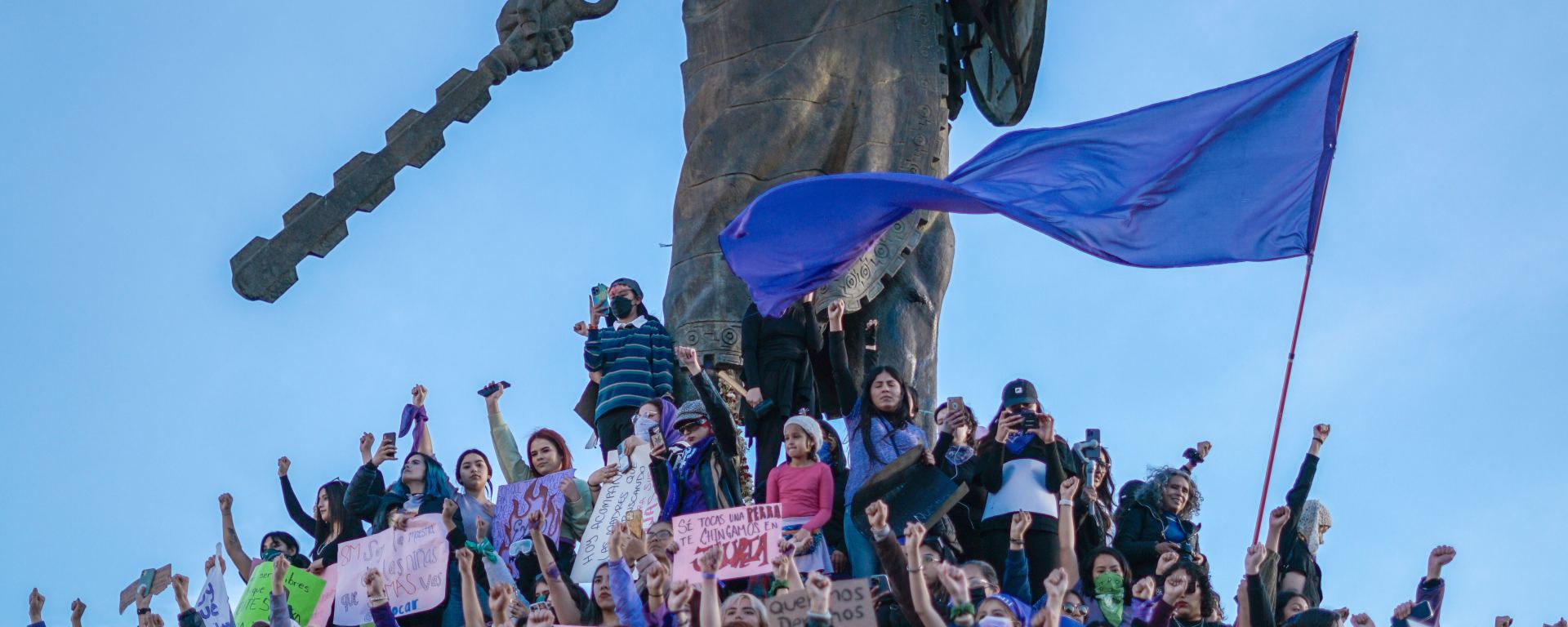
The Ni Una Menos movement emerged in response to the murder of Chiara Paez. In May 2015, the discovery of Chiara Paez’s body and the following investigation of her death revealed that she was buried alive by her boyfriend. Chiara Paez’s death was added to the long list of tragic feminicides in the country.10 As this list continues to grow, so does the degree of public outrage regarding the matter. After learning that the body of the missing fourteen-year-old girl had been found, Argentinian journalist Marcela Ojeda, tweeted: “Actresses, politicians, artists, entrepreneurs, social leaders . . . women, all women, bah..aren’t we going to raise our voice? THEY ARE KILLING US.”11 Less than a month later, journalists, writers, and celebrities turned their indignation over Chiara’s murder into organizing the first Ni Una Menos demonstration against feminicides.12 As feminist scholars, Friedman and Tabbush, put it, “the hashtag #Ni Una Menos spread virally and caught the attention of the media. They capitalized on their professional and activist networks, as well as their symbolic and social capital to great effect. Gendered and sexualized violence became the topics of talk shows, national newspapers, radio programs, Facebook, and Twitter trends.”
Faced with the ineffectiveness of the media and state, Ni Una Menos mobilized to gather empirical data and information on the structural nature of violence against women. Activists, graphic designers, journalists, and data analysts gathered to draft a self-report survey comprised of sections on harassment, discrimination, domestic violence, and obstetric violence, with variables relating to location, gender, education, economic activity, occupation, and income.14 This elaborate, more than a hundred-page-long report15found that: 97% of participants suffered at least one situation of harassment in public and private spaces; 90% of victims did not report this incident to the police. Moreover, 67% of participants suffered at least one situation of domestic abuse, and 77% were victims of obstetric violence. Regarding state complicity, only 7% of the victims of violence—95% of the sample—were able to file a formal complaint, 71% abstained from doing so, and 7% experienced push-back from the authorities.
The survey initially used terms such as “gender-based violence,” but found that only 20% of people surveyed defined gender-based violence as “the aggression suffered by a woman at the hands of a man.”17Instead, 71% of those surveyed defined it as the “abuse received by women and men alike.”18 As a result, the survey opted for the term “male/machist violence” to more accurately address the specific form of violence that women suffer at the hands of men in the Argentine context. As academics Chenou and Masmela note, “an index designed to oppose violence against women in the Argentine context required the use of a much stronger, [context-specific] expression.”
Furthermore, according to Mexican activist Lagarde y de los Rios, feminicidio (feminicide), as opposed to ‘femicide’, is better suited to describe the kinds of violence women in Central and South America face. This is because feminicide is “able to occur because the authorities who are omissive, negligent, or acting in collusion with assailants perpetuate institutional violence against women by blocking their access to justice and thereby contributing to impunity.”21In other words, while femicide is taken to be the murder of a woman because she is a woman, feminicide adds another layer, emphasizing the state’s complicity in enabling the murders. Legal scholar, Catharine A. MacKinnon’s, Toward A Feminist Theory of the State (1991) is well suited to describe the state complicity that Largade y de los Rios has in mind. As MacKinnon emphasizes, “the state is male jurisprudentially, meaning that it adopts the standpoint of male power on the relation between law and society […] time and time again, the state protects male power by embodying and ensuring existing male control over women at every level.”
Making the Invisible, Visible: Ni Una Menos’ Epistemic Activism
In Segato’s discussions on the difficulties of protesting radical and systematic forms of violence against women, Segato emphasizes the perceived “meaninglessness” that gendered violence often takes, as well as the difficulty of making sense of patterns of violence against women.24 As one of the data analysts behind the creation of the index highlights:
“Women naturalize situations of male violence because the idea of male supremacy over women persists, the patriarchal conception, the idea of women as men’s property. And if women naturalize male violence, they can’t talk about it, they cannot verbalize it, and they do not defend themselves. As such, we need to think about tools that raise awareness about the unacceptability of male violence for women and for men . . . All of this is impossible without the appropriate public policy. And public policy is impossible without information.”
By articulating new, context-specific terms, like violencia machista and feminicide, Ni Una Menos was able to make sense of women’s reality. The first step to connecting patterns of male violence and understanding its structural nature is to articulate it with specificity–allowing women and girls to realize that their experiences are not isolated or incidental, but structural. As fifteen-year-old Ofelia Fernández, President of the Student Union at an Argentine high school, expresses:
“[Our] society was 100% machista but now we are starting to hear about abortion, about women’s trafficking, feminicide…we are starting to speak about gender inequality,” she said. “Being a feminist is about understanding these realities, criticizing them, but mostly is about doing something to transform them.”
Indeed, you cannot advocate for change, fight for a cause, or implement policy reforms about a problem that people are unaware of. Change begins with consciousness raising. Doing away with the media’s narrative, and gathering verifiable, empirical data from scratch are crucial steps in raising public awareness of femicide/feminicide.
Conclusion:
Public recognition of feminicide is crucial in order for legal, economic, social and cultural change to take place within Argentinian society. Ni Una Menos’epistemic activism, not only provided an alternative to the traditional media’s complicit narrative, but also successfully reframed the public understanding of feminicide. Through the adoption of context-specific terms, like machist violence and feminicide, Ni Una Menos was able to capture the reality of violence against women in the Argentine context. The creation of the national registry of feminicides is one such example.
Article References
Cabas-Mijares, A. Ayleen, “‘Sin Mujeres No Hay Revolución:’ Transversal Feminist Politics in the Digital Mediated Activism of the Argentine Collective Ni Una Menos – ProQuest,” 2019.
https://mospace.umsystem.edu/xmlui/bitstream/handle/10355/76222/CabasMijaresAyl een.pdf?sequence=1&isAllowed=y
Chenou, Jean-Marie, and Carolina Cepeda-Másmela. “#NiUnaMenos: Data Activism from the Global South.” Television & New Media 20, no. 4 (February 22, 2019): 396–411. https://journals.sagepub.com/doi/abs/10.1177/1527476419828995?journalCode=tvna Elizabeth Jay Friedman, and Constanza Tabbush, “#NiUnaMenos: Not One Woman Less,
Not One More Death!” 2016. NACLA. 2016.
Fuentes, Marcela A.. #NiUnaMenos: Hashtag Performativity, Memory, and Direct Action against Gender Violence in Argentina.” Women Mobilizing Memory. 2019. https://www.degruyter.com/document/doi/10.7312/alti19184-011/html?lang=en#Chic ago.
Marina Prieto-Carrón, Marilyn Thomson and Mandy Macdonald, “No More Killings! Women Respond to Femicides in Central America,” Gender & Development (March 2007): 25-40.
https://nacla.org/news/2016/11/01/niunamenos-not-one-woman-less-not-one-more-de ath
MacKinnon, A. Catharine. “Toward A Feminist Theory of The State,” 1989.
Medina, José. 2022. “Philosophy of Protest and Epistemic Activism.” A Companion to Public Philosophy, March, 123–33. https://doi.org/10.1002/9781119635253.ch13.
Popescu, Irina. “Memorialization and Escraches: Ni una Menos and the documentation of Feminicidio in Argentina.” The Latin Americanist. 2021. https://muse.jhu.edu/article/805479.
 Intersections