

Written by: Aelia Deletre, Edited by: Miranda Kexin Hu
Featured Photo by Cris CL on Unsplash
With the development of intersectionality and post-colonialism theory, art historians must question the system of beliefs and institutions that fashion the field. Doing so in “The MoMA’s Hot Mamas,” Duncan looks at museums as “prestigious and powerful engines of ideology” (Duncan 1993, 191). More precisely, she explains how the works exhibited by the MoMA establish the museum as a realm of masculine control where male viewers are “the more powerful gender group” (Duncan 1993, 194; 205). Iconoclasm, the destruction of images often associated with religions’ ideological ideas, can be considered an attack on cherished beliefs and institutions. I claim that this method of deconstructing narratives is an iconoclastic approach necessary to art history. In this essay, I will use a feminist intersectional method combined with an iconoclastic approach to reveal how the stigmatization and violence against women of colour are constituted by the system of Art History. First, looking at Amaral’s The Negress (1923) and Malfatti’s Tropical (1917), I will discuss how white women obtain artistic statue by playing along with the rules set by the male-dominant institution of French art critics that marginalized and belittled women of colour. Then, I will demonstrate how questioning and destroying the “label” of formal innovation reveals representational violence in Prudence Heward’s Hester (1937).

Tarsila do Amaral (Brazilian), The Negress, 1923. Oil on canvas. Museum of Contemporary Art, University of São Paulo.
Tarsila do Amaral, a wealthy white Brazilian woman, strategically painted The Negress with a modern style inspired by Cubism to appeal to the French art critics who were obsessed with the exotic and “primitive.” During this period, when artists like Picasso and Gaugin were working, the French artistic scene expected Latin American artists, such as Amaral, to produce art presenting their national identity. Amaral included several afro Brazilian works in her 1926’s exhibition, including The Negress. It was “the first solo exhibition in Paris by a Latin American women artist to be considered avant-garde” (Greet 2018, 124). She fashioned the flat background with fragmented geometric shapes of green, white, brown and blue, which erased any sign of a recognizable time, setting and modernity. The artist created this Black woman with similar geometrical forms as her nanny in memory. Thus, the formal qualities praised by French artists and critics as “avant-garde” reduce this woman to her essential elements and form. The woman’s large body and small head follow the established stereotype linking Black women’s bodies with unrestricted sexuality and lack of intelligence. Her only large breast, while calling to the violence of fractioning her body, also makes her a symbol of fecundity. Offering the Black woman to the audience with the body’s position, she calls to this woman’s inability to own her body. Indeed, the artist was the daughter of a plantation owner, suggesting that her nanny, the “model,” was potentially an enslaved person during her lifetime. Carol Damian references this work as a celebration of the Black nanny “as the source of nourishment, […] the backbone of its society,” and notices the reference to “contemporary European artistic practices” (Damian 1999, 4). Like the French art critics who celebrated this work for its formal characteristics, Damian ignores racism. Focusing on Amaral’s exploration of forms, the system and institutions of art history failed to flag this stereotypical representation which reduces, exoticizes and violently dismember the Black woman painted. Due to her status as white upper-class Brazilian woman, Amaral had privileged access to the culture she depicted unlike most Europeans artist. Her choice to embrace the expectations of the Parisian artistic scene was a deliberate act of “strategic primitivism” under the name of “exploration of forms.” (Greet 2018, 126). As a result, Amaral was able to establish her career and artistic status.


Anita Malfatti, Tropical, 1917. Oil on canvas. (Left), Anita Malfatti, Church Interior, c.1925. Oil on canvas. (Right)
Similar to Amaral, Malfatti used primitivity and exoticism to please art critics in Paris. Also a Latin American artist from Brazil, Malfatti created Tropical in 1917, long before she arrived in France. The work shows a Black woman avoiding the viewers’ gaze as she presents a platter of fresh and exotic fruits to them. This iconography, used by Gaugin in his paintings of Tahitian girls, alludes to the sexuality and fecundity associated with women of colour. In Tropical, the platter at breast level reinforces this idea by offering her to the viewers. Malfatti also borrowed some formal innovations from contemporary artists, such as the flattening of the space and the inspiration from Cubism. In addition, the artist placed the woman in the middle of a luxuriant jungle and thus, similarly to Amaral, erased any sign of modernity. While we could speculate that she used primitivity as a strategy before Amaral, Greet emphasizes that “she almost exclusively avoided it” and “chose instead to take a different path” (Greet 2018, 130; 133). Indeed, Malfatti focused on formal innovations allowed by the decorative style, and Tropical is an expectation of her body of work. Because of French critics’ expectations, Malfatti felt compelled by the system to produce work representing her national identity. As Greet points out in her chapter, while an art critic claimed that he had a “particular aversion” for work like Malfatti’s Church Interior (1942), he responded positively to Tropical, calling it “colorful and agreeable” a year later (Greet 2018, 85). This striking and concrete example demonstrates the expectations Malfatti had to face in Paris and explains her deliberate choice to include Tropical in her exhibition of 1925.
While I flagged the responsibility of the system of French art critics and the art scene of Paris, it is also essential to emphasize the artists’ responsibilities. Indeed, the white upper-class Brazilian women painted “primitive” and exotic works and achieved similar success during their lifetime. However, Malfatti’s painting is less reductive than Amaral’s depiction. Amaral used stereotypical elements such as bigger lips and feet-like hands, stripping off the clothes of her “nanny,” deforming and fragmenting her body. In contrast, Malfatti’s kept her subject clothed and gave her a certain agency and interiority. Thus, while I have demonstrated that female artists did not have much choice in their subject matter and artistic style, and even though it does not excuse their racist representations, it is important to note that they could choose to what extent they embraced the reductive ideas and expectations of the system they were working in, in exchange for their success.
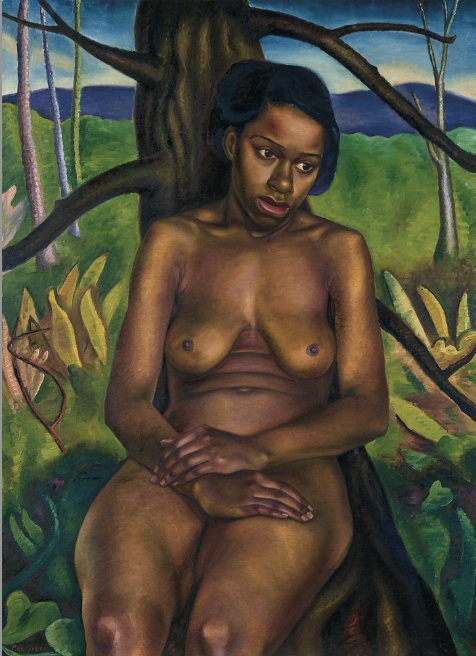

Prudence Heward, Hester, 1937. Oil on canvas, Agnes Etherington Art Centre, Kingston. (Left), Prudence Heward, Girl Under a Tree, 1931. Oil on canvas, Art Gallery of Hamilton. (Right)
Heward’s racist depiction of Hester, informed by her travel to the Caribbean and the eugenic discourses circulating in Canada, demonstrates the value accorded to artistic innovation over violence in the representation of Black subjects. Unlike Amaral or Malfatti, Heward was already successful and did not need to paint Black women to obtain a certain respect in the field of art history. While she painted only one nude of a white woman, all her depictions of Black women except one were naked. Hester, seated in a three, has visible skin folds, skin discolorations, and her breast is exposed and raised by the gesture of lifting her arm. This representation of the female body contradicts the pale marble skin and the female nude’s stereotype in paintings since the Renaissance. Behind her, Heward painted a luxuriant jungle and included an exotic plant, the sumachs, also native to Canada. Found by the viewers in the wild, the deliberate choice of the artist removes any signs of modernity again. In a protective position, the subject covers her genitalia while her gaze stares into the void with melancholia. This reductive and exotic representation of a female nude highly contrast with Hewards’ Girl Under a Tree (1931). Still, in nature, the modernity of this white woman is recalled by the city in the background and her makeup. In addition, she chooses to show her highly idealized and muscular body to the viewer. Considering this comparison and drawing from Charmaine Nelson’s statement that this work “speaks to an imbalance of power between a white female artist and Black female models” (Skelly 2015, 33). I claim that Hester is an example of representational violence. With the different artistic choices Heward made, she violated, reduced and “exoticize[d] the female subject and position[ed] her as ‘other’ in relation to white Canadians” (Skelly 2015, 31). While the system of art critics and curators mostly ignored this issue, Natalie Luckyj “suggests that Heward’s paintings of Black women provided the artist with an opportunity to ‘explore the potential of unusual and dramatic colour harmonies’” (Skelly 2015, 31). Thus, this demonstrates the repetitive pattern of art history institutions to justify the reductive representation of women of color through formal explorations and innovations.
Discussing these three works, I illustrated the need to destroy the “label” of formal innovations in order to look at the harmful representations it hides. While Amaral purposely embraced the racist discourses desired by art critics, Malfatti mostly maintained a distance with primitivism. Nevertheless, both choose to exoticize Black women to secure a certain artistic status. Heward’s choice to represent a Black subject comes from the eugenics discourses circulating in Montreal. The representational violence in her work, especially evident when looking at her depiction of white subjects, was ignored in favour of artistic explorations. In conclusion, while it is crucial to deconstruct artworks, it is also necessary to address the role of museums, curators, and art critics in this discussion, as they are the first to praise artistic renewal (Duncan 1993, 190). As I showed in this essay, an iconoclastic approach of destroying those sets of beliefs and institutions, joined with an intersectional feminist method, can explore the harm done by these discourses.
References:
Damian, Carol. “Tarsila do Amaral: Art and Environmental Concerns of a Brazilian Modernist,” Woman’s Art Journal, vol. 20, no.1 (1999).
Duncan, Carol. “The MoMA’s Hot Mamas,” in The Aesthetics of Power: Essays in Critical Art History, 189-207. Cambridge: Cambridge University Press, 1993).
Greet, Michele. “‘Exhilarating Exile’: Four Latin American Women Exhibit in Paris,” In Transnational Encounters: Latin American Artists in Paris Between the Wars, 122-44. New Haven: Yale University Press, 2018.
Skelly, Julia. Prudence Heward: Life & Work. Toronto: Art Canada Institute, 2015.
 Intersections