
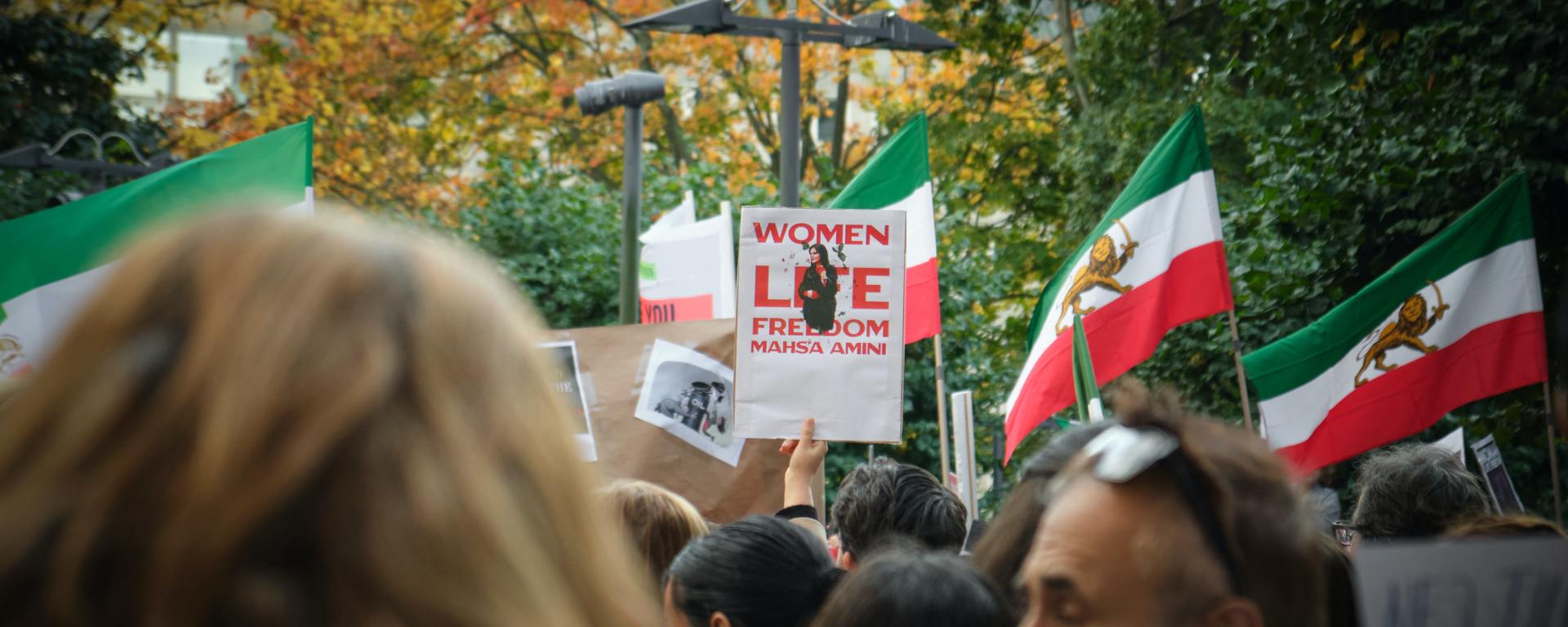
Featured Photo by Artin Bakhan on Unsplash
Written by Spandy Balanaga, edited by Shannon Salick
Revolution has swept Iran following the brutal murder of 22-year-old Mahsa Amini in police custody. Even though it has been over six weeks since her death, tens of thousands of people are still protesting Iran’s conservative regime and its morality police.
In 1983, wearing a headscarf became mandatory for all women, punishable by imprisonment. The recent election of conservative president Ebrahim Raisi has exacerbated its enforcement, particularly through the increasingly extreme actions of the morality police. Amini’s murder, however, appears to be the last straw for citizens.
Protestors have been reported burning their scarves and cutting their hair as an act of resistance; according to the BBC, at least 200 people have been killed by authorities for this defiance. The government has also been throttling internet access in order to limit the ability of protesters to organize, and numerous journalists involved in reporting Amini’s case have been incarcerated. On October 15, the notorious Evin prison in the capital, Tehran, burned down resulting in at least eight casualties. Though the government denies any association to the protests, the Evin prison housed hundreds of arrested protestors.
International response has included sanctions and denouncements of the Iranian government. The United States has also attempted to increase public access to internet services, however, many see this as performative considering the fact that most Iranian citizens would be unable to afford to access these new service providers. Canada has made a $76 million investment in expanding its sanctions; it has also labeled the Iranian Revolutionary Guard Corps (IRGC) a terrorist group, and banned members of the Iranian government from amnesty in Canada.
During this discussion, it is imperative to remember that the Western media walks a delicate line between support and saviourism. Often, Western reporting adopts a position of moral superiority that can quickly dissolve into xenophobia. Critically, I want to emphasize that these protests are occurring in opposition to the regime, not the religion; portraying the demonstrations as simply a rejection of Islam is reductive and ultimately harmful. In writing this article, I have seen many journalists juxtapose this oppression with the supposed liberty of the West. This is deeply ironic considering that Quebec itself maintains a headscarf ban – arguably just as oppressive as a mandate.
All in all, the protests do not appear to be dying down; in fact, people worldwide have been rising in solidarity with the people of Iran. Activists are demanding the dismantlement of the government, prosecution of Amini’s killers, and the protection of civil rights, amongst other things. As more and more people join the fight, we find ourselves closer to triumphing in the global fight for bodily autonomy.
Sources:
- https://www.voanews.com/a/iranians-strike-as-mahsa-amini-protests-enter-sixth-week/6800926.html
- https://www.aljazeera.com/news/2022/10/16/fire-clashes-at-irans-evin-prison-holding-political-prisoners
- https://www.nbcnews.com/news/world/iran-mahsa-amini-protests-fire-evin-prison-tehran-ayatollah-khamenei-rcna52444
- https://www.npr.org/2022/10/06/1127235683/iran-sanctions-protests-mahsa-amini
- https://www.bbc.com/news/world-middle-east-63240911
- https://home.treasury.gov/news/press-releases/jy0969
- https://www.economist.com/the-economist-explains/2022/09/26/who-are-irans-hated-morality-police
- https://www.iranintl.com/en/202210168855
 Intersections